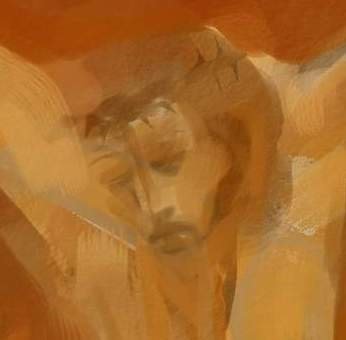
Saturday, April 07, 2007

Good Friday


READING John 19:16b-25a
16b So they took Jesus; 17and carrying the cross by himself, he went out to what is called The Place of the Skull, which in Hebrew is called Golgotha. 18There they crucified him, and with him two others, one on either side, with Jesus between them. 19Pilate also had an inscription written and put on the cross. It read, "Jesus of Nazareth, the King of the Jews." 20Many of the Jews read this inscription, because the place where Jesus was crucified was near the city; and it was written in Hebrew, in Latin, and in Greek. 21Then the chief priests of the Jews said to Pilate, "Do not write, 'The King of the Jews,' but, 'This man said, I am King of the Jews.'" 22Pilate answered, "What I have written I have written." 23When the soldiers had crucified Jesus, they took his clothes and divided them into four parts, one for each soldier. They also took his tunic; now the tunic was seamless, woven in one piece from the top. 24So they said to one another, "Let us not tear it, but cast lots for it to see who will get it." This was to fulfill what the scripture says,
"They divided my clothes among themselves, and for my clothing they cast lots."
25aAnd that is what the soldiers did.

The Lord has laid on him the iniquity of us all:
for the transgression of my people was he stricken.


In the name of Jesus; amen.

We had a phrase in high school, when we would see people being intimate with one another out in public. You know what I’m talking about when I say being intimate with one another out in public… making out at the mall or touching that went beyond holding hands out on the street. The phrase we would use was: “PDA” or “public displays of affection.”

It wasn’t something we needed to see except maybe in an R rated movie or on a soap opera. Sometimes one of us would be brave enough to say out loud, “Get a room” and hope the couple would get the hint that their behavior was inappropriate.

There are some things that aren’t meant for public consumption. There are some things that should be kept behind closed doors. There are some things that should not be publicized for the world to see.

“16b So they took Jesus; 17and carrying the cross by himself, he went out to what is called The Place of the Skull, which in Hebrew is called Golgotha. 18There they crucified him, and with him two others, one on either side, with Jesus between them. 19Pilate also had an inscription written and put on the cross. It read, "Jesus of Nazareth, the King of the Jews." 20Many of the Jews read this inscription, because the place where Jesus was crucified was near the city; and it was written in Hebrew, in Latin, and in Greek.”
There were a lot of Jews in Jerusalem; it was around the time of the festival and Jews from all over the known world passed by the place where Jesus hung. They would have been people who spoke: Hebrew, Latin, and Greek. And there weren’t just Jews using that road. Other people, gentiles, would have found occasion to travel outside the city as well.

They would have seen the spectacle. Mothers would have shielded their children’s eyes as they passed, Fathers would have hurried their families along so that the image would have been blurred. Some would have stopped or slowed down, the way we do when we pass an accident on the road.

They would have read the sign, seen the blood, smelled the smell of death and sweat. Some would have taunted, others would have cried, and still others would have been indifferent. But they would have been witnesses and they would have known that the charge against this dying man was that he was the King of the Jews.

It was a public claim and a public death. It didn’t happen in a secluded room or in a cell deep within prison walls. It didn’t happen in an R rated movie or on daytime television when the kids are in school.

This was a PDA, a public display of affection.

Last week, I found myself explaining Salem’s Palm Sunday service to my almost 8 year old daughter. Our service is a little different than others. We focus, not on the triumphant entry of Jesus into Jerusalem, but on Jesus’ passion and death. The service begins on a happy note; we wave our Palm branches and process around the church singing, “All Glory Laud and Honor to you redeemer King!” But soon enough the story of Jesus’ betrayal and death becomes more and more evident. We finish the service in silence and reflection after singing, “Were you there when they laid him in the tomb?”

“Why do we have to have services about bad things? She asked.

There is a reason why we don’t like PDA’s. They are personal moments, intimate things and we especially don’t want our children to see them, because it exposes them to stuff they aren’t meant to understand quite yet.

Except for this… except for this PDA of Jesus’ death.

“Well,” I said. “We want to remember this thing that Jesus did for us. We want to remember that Jesus loved us so much that he was willing to let bad things happen to him so that we would know that when bad things happen to us that he understands and that he is with us no matter what we go through.”

But there is more to it than just that. Jesus’ death was a public event because it was meant to be witnessed. We are meant to be witnesses to his suffering, to be pulled in and gawk at it, to experience it. It wasn’t meant to be a secret event that is whispered about or buried on the back page of the papers. We aren’t supposed to hurry past it or shield our eyes and try to forget.

This PDA is supposed to be public; this intimate act is supposed to be seen.

And it’s not just so that we get the idea that Jesus suffered for us. Hanging on the cross with Christ were all our sins and we are to be witnesses of that too.

Jesus aired out our dirty laundry on the cross and then washed it clean with sweat and blood. Publicly, Jesus took our sins, our failures, our guilt and claimed them on the cross. He let them be nailed up there with him for all the world to see and then changed them with each drop of blood and every agonizing breath.

Publicly, God recreated us in love. God threw arms around us and kissed us for all the world to see; God touched us intimately and proclaimed, “This is my love.”

It couldn’t be hidden, locked up in some room, shown only in secret when no one else was around. Jesus’ death was a public display of affection for the whole world.

Be a witness to it, let it pull you in, experience it, and live it publicly.


Amen.


Friday, April 06, 2007

Maundy Thursday


a sermon based upon

In the name of Jesus; amen.

Last week my father called and asked when I was going to do his feet. It has become a tradition since coming to CT that I set aside some time to give my dad a pedicure each year before Maundy Thursday.

Now I love getting pedicures; it is an indulgence and when I have the ability to go and have my feet done I jump at the chance. So I try very hard to give my dad a nice pedicure when he asks because I know that he won’t indulge in going to a salon to have a professional do it for him.

There are some people who don’t like to have their feet touched. Feet are a funny thing. Maybe they don’t like how their feet look and so they are embarrassed to have someone else see them or maybe they are ticklish and so they can’t stand to have someone else touch them without breaking into laughter.

And so, this night is an odd night when we pull out a basin and invite everyone to come forward with bare feet and have someone else pour water over them and then take a towel to dry them off. It’s not quite a pedicure… but it is still a strange ritual inserted right in the middle of the service where we remember Jesus’ last meal with his friends.

If you are uncomfortable with the idea of coming forward, that’s ok. Like I said, there are people who just don’t like to have their feet touched and no one should worry about what others will think if they come forward, sit in the chair, and get their feet wet or not.

It was a strange thing that Jesus did. Right in the middle of supper he gets up, takes off his robe, ties a towel around his waste, gets a basin, and going from disciple to disciple begins to wash their feet.

But it wasn’t that their feet were dirty and Jesus just couldn’t stand it anymore so he decided to wash them himself. Jesus knew that his hour had come to depart from this world and go to the Father. And having loved his own who were in the world, he loved them to the end…

Their feet were already clean. Feet were washed upon entering a home to take off the dirt and sand that they had walked through outside. Their hands would also have been washed… it was part of the meal-time ritual to wash one’s hands before eating.

This wasn’t something that Jesus had to do for them… it was something he did because he loved them. He was their teacher, their master, the one who they followed and suddenly there he was touching their feet, washing them, and drying them right in the middle of supper.

I’m sure they were all perplexed and a bit surprised, but it is Peter who speaks up… who brings up the weirdness of it. “Are you going to wash my feet?”

His feet were clean, they didn’t need to be washed and certainly he didn’t want Jesus to wash his feet. He should be washing Jesus’ feet if there was going to be any foot washing… but Jesus insists.

And something happens… Jesus is no longer master, but servant and friend. A new relationship begins for those gathered that night. They might not understand it at first, but later they will when they discover that the tomb is empty and Jesus stands, resurrected, in front of them. Later, they will understand why their feet were washed when Christ gives them a new mission to preach the gospel to the world.

Later they will understand that Jesus was sent to care for them so that they might care for others… that he loved them so that they might love others just as he loved them.

It was an odd thing to wash their feet right in the middle of supper. But Jesus did it so that they might understand their need to feel loved by him and to not resist that need or his love. We need the love of Jesus… love that is poured out in the water of washing and in the bread and cup of his supper. It is love meant to give us a part of him and to make us a part of his love.

It is love that makes us friends: friends of Christ and also friends to others, to those Christ has called us to serve.

Jesus’ love changes us. It makes us bare our feet and extend our hand. It makes us stop resisting our need for mercy, forgiveness, and love. And it fills us with a desire to serve, not because we are servants or less than others, but because it transforms our relationships with others.

This night, filled with odd traditions and a meal of ordinary stuff that becomes Jesus’ own body and blood is a night of transforming love, love that gets into us and wants us to share it with others.

Let it transform you, even if you don’t get your feet wet. Let it transform you as you come to the table. Let it transform you into a friend. Amen.

Sunday, March 25, 2007

Lent 5

A sermon based upon John 12:1–8

In the name of Jesus; amen.

Maybe it was purchased for Lazarus when he was sick and dying, or it was the family’s stash for use when one of them died. It was a good spice to use for the dead, because it was so strong and fragrant and covered the smell. Perhaps it was money in the bank. Expensive and pricey it could have been sold in the event of an emergency or turned into cash for other investments. Or it could have been used for retirement or as a dowry for marriage.

Whatever reason this family had it, it was of great value to them. It might have even been the single most valuable thing this family owned… and there she was, at his feet, pouring it over them… every last drop.

Good God, what was she doing? The oil, worth a year’s salary, dripped from his toes, his ankles, the soles of his feet and she was wiping them with her hair.

A stunned silence permeated the air alongside the smell of it; it filled the whole house and their sinuses. It got into their clothes, in their hair, and on their skin. It was the smell of death and love mixed together.

Have you ever been hit by a strong, unmistakable smell? One that filled your nose and took over your senses? One that pulled you so deeply into the moment in which you were in that it stopped you cold?
They say that the sense of smell is perhaps the strongest of our senses. We taste almost as much with our nose as we do with our tongue. The sense of smell has the ability to weaken our stomachs, elate us, and pull us into memories of things we have long forgotten. And this smell would have filled their very souls.

It was a sensual, intimate, extravagant act that Mary performed; done right in the middle of dinner, in front of all the company. As a custom, people ate while reclining; everyone would have seen what she was doing and if their view was obscured so that they missed seeing it then they would have smelled it, put down their food, stopped talking in the middle of what they were saying and watched as Jesus looked at Mary wiping his feet with her hair.

What happened in that moment between them was deep and emotion-filled… it was a holy and personal moment… and then Judas opened his mouth.

John, the gospel-writer/story teller tells us his motives: Judas is a thief who steals from the common purse which has been entrusted to his care by Jesus and the other disciples.

Judas saw Mary wasting what could have fetched a large amount of money, at least 300 denarii, what might be equivalent to about $2,000 today. It was money he could have used to line his own pockets and so he spoke out against her actions. “Why was this perfume not sold for three hundred denarii and the money given to the poor?” Maybe he was a thief, but it’s quite possible that he wasn’t the only one in the room with that or a similar thought.

Jesus talked a lot about the poor. He often told people that they should give all they had to the poor. Jesus criticized greed and waste. And there he was… letting this woman pour out her family’s most valued asset onto his feet. There he was, letting her wipe it away with her unbound hair.

John does not share Mary’s reason for doing what she did that night at dinner, but Jesus does, “Leave her alone.” He tells Judas and the rest. “She bought it so that she might keep it for the day of my burial. You always have the poor with you, but you do not always have me.”

Maybe she knew. Mary was a listener so maybe she had heard him talk about what was about to happen when he reached Jerusalem. What she did know was that not long before he had arrived at her home and called her brother out of his grave and so maybe this was her way of saying thank you, or I love you, or I know you are going to die and I have to do something for you that matters, really matters.

Whatever her intentions, she poured out for him her thing of greatest value and it filled the room with its scent and lingered.

The extravagance of love lingers. It lingered with Jesus, who on the night he was betrayed stooped down and washed the feet of his friends. It lingered with Jesus and mixed with his sweat as he carried the cross to the place of his death. It lingered with Jesus in his dying breath. It lingered with him in the tomb where the extravagance of God’s love did something that lingers with us today.

Can you smell it? The smell of God’s grace filling the house, entering our nasal passages, seeping into our pores?

Can you smell what extravagant love can do; extravagant love for God, love that unbinds our hair, and our senses, and brings us to the feet of Jesus?

Love that says, thank you, and I love you, and I know that you died out of love for me.

Be extravagant with your love; do not hold it back. Jesus says that Mary bought the perfume for the day of his burial, but she doesn’t wait until he is dead to use it. Be extravagant with your love; pour it out for others to smell and taste and see and hear and feel.

For God is extravagant with love for us, love that lingers and lasts for all time.

Amen.

Lent 4


This week's sermon was preached without a manuscript.

Here are two versions of the story that Jesus told:

Eugene Peterson's The Message:
Gospel Luke 15:1–3, 11b–32
1 By this time a lot of men and women of doubtful reputation were hanging around Jesus, listening intently. 2 The Pharisees and religion scholars were not pleased, not at all pleased. They growled, "He takes in sinners and eats meals with them, treating them like old friends." 3 Their grumbling triggered this story.

11 Then he said, "There was once a man who had two sons. 12 The younger said to his father, 'Father, I want right now what's coming to me.' 13 It wasn't long before the younger son packed his bags and left for a distant country. There, undisciplined and dissipated, he wasted everything he had. 14 After he had gone through all his money, there was a bad famine all through that country and he began to hurt. 15 He signed on with a citizen there who assigned him to his fields to slop the pigs. 16 He was so hungry he would have eaten the corncobs in the pig slop, but no one would give him any. 17 "That brought him to his senses. He said, 'All those farmhands working for my father sit down to three meals a day, and here I am starving to death. 18 I'm going back to my father. I'll say to him, Father, I've sinned against God, I've sinned before you; 19 I don't deserve to be called your son. Take me on as a hired hand.' 20 He got right up and went home to his father. When he was still a long way off, his father saw him. His heart pounding, he ran out, embraced him, and kissed him. 21 The son started his speech: 'Father, I've sinned against God, I've sinned before you; I don't deserve to be called your son ever again.' 22 "But the father wasn't listening. He was calling to the servants, 'Quick. Bring a clean set of clothes and dress him. Put the family ring on his finger and sandals on his feet. 23 Then get a grain-fed heifer and roast it. We're going to feast! We're going to have a wonderful time! 24 My son is here - given up for dead and now alive! Given up for lost and now found!' And they began to have a wonderful time. 25 "All this time his older son was out in the field. When the day's work was done he came in. As he approached the house, he heard the music and dancing. 26 Calling over one of the houseboys, he asked what was going on. 27 He told him, 'Your brother came home. Your father has ordered a feast - barbecued beef! - because he has him home safe and sound.' 28 "The older brother stalked off in an angry sulk and refused to join in. His father came out and tried to talk to him, but he wouldn't listen. 29 The son said, 'Look how many years I've stayed here serving you, never giving you one moment of grief, but have you ever thrown a party for me and my friends? 30 Then this son of yours who has thrown away your money on whores shows up and you go all out with a feast!' 31 "His father said, 'Son, you don't understand. You're with me all the time, and everything that is mine is yours - 32 but this is a wonderful time, and we had to celebrate. This brother of yours was dead, and he's alive! He was lost, and he's found!'"


New Revised Standard Version:
Gospel Luke 15:1–3, 11b–32
1 Now all the tax collectors and sinners were coming near to listen to him. 2 And the Pharisees and the scribes were grumbling and saying, "This fellow welcomes sinners and eats with them."
3 So he told them this parable: 11 There was a man who had two sons. 12 The younger of them said to his father, 'Father, give me the share of the property that will belong to me.' So he divided his property between them. 13 A few days later the younger son gathered all he had and traveled to a distant country, and there he squandered his property in dissolute living. 14 When he had spent everything, a severe famine took place throughout that country, and he began to be in need. 15 So he went and hired himself out to one of the citizens of that country, who sent him to his fields to feed the pigs. 16 He would gladly have filled himself with the pods that the pigs were eating; and no one gave him anything. 17 But when he came to himself he said, 'How many of my father's hired hands have bread enough and to spare, but here I am dying of hunger! 18 I will get up and go to my father, and I will say to him, "Father, I have sinned against heaven and before you; 19 I am no longer worthy to be called your son; treat me like one of your hired hands." ' 20 So he set off and went to his father. But while he was still far off, his father saw him and was filled with compassion; he ran and put his arms around him and kissed him. 21 Then the son said to him, 'Father, I have sinned against heaven and before you; I am no longer worthy to be called your son.' 22 But the father said to his slaves, 'Quickly, bring out a robe — the best one — and put it on him; put a ring on his finger and sandals on his feet. 23 And get the fatted calf and kill it, and let us eat and celebrate; 24 for this son of mine was dead and is alive again; he was lost and is found!' And they began to celebrate.
25 Now his elder son was in the field; and when he came and approached the house, he heard music and dancing. 26 He called one of the slaves and asked what was going on. 27 He replied, 'Your brother has come, and your father has killed the fatted calf, because he has got him back safe and sound.' 28 Then he became angry and refused to go in. His father came out and began to plead with him. 29 But he answered his father, 'Listen! For all these years I have been working like a slave for you, and I have never disobeyed your command; yet you have never given me even a young goat so that I might celebrate with my friends. 30 But when this son of yours came back, who has devoured your property with prostitutes, you killed the fatted calf for him!' 31 Then the father said to him, 'Son, you are always with me, and all that is mine is yours. 32 But we had to celebrate and rejoice, because this brother of yours was dead and has come to life; he was lost and has been found.'"

Lent 3


A sermon based upon Isaiah 55:1–9 and Luke 13:1–9

In the name of Jesus; amen.

Jesus was surrounded by a large crowd and preaching to his disciples about how one should live their life. It was a sermon filled with warnings about being prepared and being faithful and as he was preaching some in the group spoke up and mentioned an incident in which Pilate had squashed an uprising in Galilee and blood had been spilled.

We aren’t told exactly what they said to Jesus, but by his response we might imagine something like this was said: “They must have been really awful sinners to have something like that happen. Wasn’t that terrible? They really must have deserved it; don’t you think so, Jesus?”

There was no question that what had happened was a terrible thing and when terrible things happen it’s a natural thing to want to justify why it happened, but listen to what Jesus says:

“Do you think,” he asks, “that because these Galileans suffered in this way that they were worse sinners than all other Galileans? No, I tell you; but unless you repent, you will all perish as they did. Or those eighteen who were killed when the tower of Siloam fell on them – do you think that they were worse offenders than all the others living in Jerusalem? No, I tell you; but unless you repent, you will all perish as they did.”

In the recent past there have been some great large-scale tragedies. Who can forget the towers that fell on 9/11? Or the tsunami that hit Indonesia in 2004? Or hurricane Katrina that destroyed the gulf coast? Or the killing of Amish girls in a one-room school house?

Each time great tragedies occur in the world or in our personal lives we wonder why.

The people who mention the Galilean tragedy have a theory on the why: they were sinners and deserved it.

We shouldn’t be surprised; we’ve heard similar theories associated with recent tragedies. For instance did anyone hear the theory that New Orleans was wiped out because it was a city of sin and God wanted to punish those living there so he sent Katrina?

The people who approach Jesus wanted to point fingers, to have a good excuse for why such an awful thing would have happened, but they also wanted something else. They wanted some sort of assurance that they weren’t like those who had been killed.

What Jesus tells them is that tragedies happen and they happen without reason sometimes and they happen to people no matter what kind of sinner they are. Sometimes bad things happen to good people and sometimes bad things happen to bad people and so we can’t judge a person’s sinfulness based upon the blessings or curses they receive.

That is the first part. Here’s the second: life is short and we can’t assume that everything will be great for us just because.

Jesus tells a parable about a fig tree. For three years the owner of the fig tree comes looking for fruit on it and finds none, so he tells the gardener to cut it down. But the gardener pleads for it and offers to take special care of it in hopes that it will produce for its owner.

The people wanted Jesus to talk bad about those whom Pilate killed, but instead of Jesus getting pulled into their finger-pointing talk he pointed the finger back at them. Those who suffered tragedy were not worse sinners than others who deserved to be punished but we are all sinners for whom tragedy may very well occur.

Jesus tells them to repent. Jesus tells us to repent because our time is limited. Do it now, because there may not be a later. But don’t be confused, repentance is not a one time act and then everything is ok. Jesus isn’t suggesting we just say that we are sorry and ask for forgiveness. Instead Jesus wants us to live repentant-ly; he wants us to live fruitfully.

Isaiah says it this way: “Why do you spend your money for that which is not bread, and your labor for that which does not satisfy? Listen carefully to me, eat what is good, and delight yourselves in rich food. Incline your ear, and come to me; listen so that you may live.”

Living a repentant life, a fruitful life is living a life of constant desire for God. It isn’t esoteric or metaphoric, it is physical and real. It is purposeful life lived not in judgment of others but in service to God through our relationships and care of others.

In other words… we aren’t meant to do good in order to be saved or avoid tragedy, but in order to be fruitful. If God has given us more time it is for the purpose of fruitfulness.

Jesus wants us to be fruitful which means constantly turning to God for good things rather than wasting our money and labor for that which does not satisfy.

And we have been given another year to do this. That’s grace… unbelievable grace. God so desires our fruitfulness that we are given more time to produce, but time isn’t the only thing we are given. Jesus, the gardener makes a promise to fertilize the ground in which we are planted… to give us that which we need to be fruitful in the time we have been granted.

And why does God want us to be fruitful? Because a fruitful life is a full life. It is a life of rich things that satisfy instead of things that leave us thirsty and hungry. It is a life where tragedy and sin do not have the final word in our lives and this is the desire that God has for us. God desires our lives to be full and filled with good things. God wants to provide the thirsty with water and those with nothing enough to buy wine and milk… drinks of celebration and goodness.

And so we have been given another year and fertilizer; the things that help us to grow. Be fruitful and repentant and may the grace of God bless you with fullness and new life. Amen.

Lent 2


A sermon based upon Luke 13:31–35


In the name of Jesus; amen.

At that very same hour some Pharisees came and said to him, “Get away from here, for Herod wants to kill you.”

Jesus was causing trouble and he was doing it on the Sabbath. He was preaching about God and had just healed a woman who had a physical ailment which had bent her over for 18 years. He had called the leader of the synagogue a hypocrite and the people were eating him up when suddenly some Pharisees come and tell him to run away.

At first it might seem as though they were trying to help Jesus by warning him of impending danger. This was the same Herod who had beheaded Jesus’ cousin, John the Baptist and his father was the one who had slaughtered innocent children in hopes of killing the baby Jesus. Herod might very well have been after him and would have had the means necessary to kill him.

It sounds as though they were trying to help.

Listen again to what Jesus tells them upon hearing his life is in danger: “Go and tell that fox or me, ‘Listen, I am casting out demons and performing cures today and tomorrow, and on the third day I finish my work. Yet today, tomorrow, and the next day I must be on my way, because it is impossible for a prophet to be killed outside of Jerusalem.’”

Jesus doesn’t sound too afraid, does he? In fact he sounds remarkably unafraid. We know why. Herod is not a threat; Jesus is on a mission that will take him to Jerusalem where he knows death is not going to come from Herod, but from the people who hand him over to be crucified.

He calls Herod a fox; an animal not considered the most cunning or ferocious in Jesus’ day. Herod is more of a nuisance than a threat to Jesus.

Maybe those Pharisees who come to warn Jesus were worried about him, but more likely they were worried about the trouble that Jesus was causing. If Herod was out to get him then the Pharisees didn’t want the trouble that would come with Herod’s desire to hurt him. Not that Jesus wasn’t already causing trouble, because he was; and if they got him to leave well… that might be better for them in every respect, or so they thought.

After calling Herod a fox Jesus makes it clear that he is headed for Jerusalem and he is going there because it is impossible for a prophet to be killed outside of Jerusalem. “Jerusalem, Jerusalem,” he laments, “the city that kills the prophets and stones those who are sent to it! How often have I desired to gather your children together as a hen gathers her brood under her wings, and you were not willing!”

The Pharisees want Jesus to move along or change his message. They were happy with the status quo and Jesus was messing it up for them.

Jesus calls Herod a fox, but he likens himself to a mother hen wanting to gather her chicks under her wings. It’s a beautiful metaphor… Jesus as mother.

Hens gather their brood under their wings when there is danger from a predator. They call out to them and make their wings into a protective dome with an opening large enough for all of them to gather under.

This is Jesus, a stark contrast to the fox Herod who wants to kill him and the Pharisees who want him to abandon them. Jesus’ desire is to offer shelter and protection to unwilling chicks.

Herod was the king of the Jewish people, but he was not a religious man. He was too concerned with his own well-being and status to give much credence to God. He was king at the pleasure of Rome and he served them… not the people. And the Pharisees, while religious, did not want to upset the boat. They liked their rules and their notions about holiness.

The message that Jesus preached upset their world… it was an upsetting message not because it was exclusive, but because it was too inclusive. It let too many people in under its wings and called them to reconsider too closely what made a person blessed.

Jesus’ message was for all; his motherly wings large enough to gather the whole world to his breast, but it meant a different life and that scared people.

It still scares people… this idea of being gathered under Jesus’ motherly wings. It’s why there are churches out there growing by leaps and bounds who do not display a cross anywhere or anytime in their worship. It’s why there are churches out there growing by leaps and bounds that preach that Jesus wants us to be rich and drive expensive cars. It’s why there are churches out there growing by leaps and bounds that tell its members that only they will be saved while the rest of humanity will be left behind to suffer eternal torment.

And yet, Jesus wants to gather us in and shelter us… all of us under the message of God’s love and grace like a mother hen gathers her chicks together under her wings.

This is why he made his way to Jerusalem even though he knew that Jerusalem meant his death; because the cross is meant to gather us and shelter us. The cross is meant to embrace us, not in death, but in new life. The cross is meant to hold us and cover us with all the blessings of God.

These wings of Jesus, this cross of Christ, is for all… be willing and be sheltered. Amen.

Lent 1


A sermon based upon Deuteronomy 26:1–11

In the name of Jesus; amen.

From our bulletin’s introduction today:

The Lenten discipline is a spiritual struggle. In the confession of sins we acknowledge that we struggle and seek God’s strength. Jesus struggles with us, and so we are sustained. Help is as close as a prayer and a confession that we cannot do it on our own. God gives life and its fruit, and so all we offer in worship is giving back what was first given us by grace.

The Lenten discipline is a spiritual struggle. We begin with Ash Wednesday where we are reminded of our death and sin and as the week begins anew we hear about Jesus’ temptation in the wilderness.

Lent always begins this way as if the readings are trying to discipline us into the season. We are mortal, sinners, and we are tempted they tell us.

Lent can feel like it is a real drag and the traditions that go along with this season are an equal drag. Traditionally Lent is a time of purging. We give things up for Lent; we stop eating meat and chocolate and we pack up the “A” word in a box to be opened at Easter. Our spiritual struggle takes on physical attributes.

Lent is a time of giving things up and depriving ourselves of those things we really enjoy… at least that’s what people say.

To be honest I’ve never been fond of the idea of giving something up for Lent. After the noon worship service on Wednesday I walked through the hall downstairs, ashes all over my forehead, and was bombarded by questions from some of the day care children. “Why do you have marker all over your face?” I was asked. Edwin, one of the teachers explained that I had ashes on my face, not marker. “Why do you do that? What’s Ash Wednesday?”

“It’s the first day of Lent,” I told them. “And we put ashes on our face to remind us how much we need God.”

Edwin then joked with me that he was giving up work for Lent. “Can’t do that,” I told him. “Ok,” he said, “then I’ll give up school.” (Edwin is studying to become a teacher.) “Instead of not doing something,” I suggested. “Why not do something positive and good for Lent?” He smiled and went back to playing with the kids in the hall.

The Lenten discipline is a spiritual struggle, but it has tangible consequences. It doesn’t matter if you struggle with giving something up or adding a new discipline; the practices of Lent are meant to test us until we understand that without God we can do nothing.

In our first reading this morning from Deuteronomy I am struck by the amount of times that the reader is reminded of what God has given. Six times some form of the word “give” is used in the eleven verses we read. And each time it refers to what God has given the people.

It is an interesting coincidence that this is our first reading because throughout this Lenten season we will be talking about stewardship and stewardship begins with the understanding that all we have comes from God.

The ancient people, including those Hebrews who celebrated the rituals explained in Deuteronomy, would take a portion of their first crops and sacrifice them to the gods, or in the case of the Hebrews… to God.

If you’ve ever heard the term: “First Fruits” this is where it came from. It was the practice of giving to God the first of their abundance. Even more ancient cultures would take this practice so far as to sacrifice their first born son. (Do you remember the story of Abraham almost sacrificing Isaac?)

It was an act of pure, unadulterated faith to do something like this. To sacrifice your first crop, even a portion of it meant that there was that much less for the rest of the year. What if there was a famine? What if some natural disaster took place and destroyed all the rest that they counted on?

And yet, they did it. They did it because ultimately they knew that the land they lived on had come from God. It was God’s and all they received from it was from God.

In grade school I had a teacher who told us a story about how her daughter wanted to run away from home. She told her that if she wanted to run away that she could go right ahead, but that she couldn’t take anything with her… no toys, no clothes, no nothing, because everything that her daughter had belonged to her. Yes, she had given those things to her daughter, but ultimately they belonged to her because she had been the one to go shopping and to pay for them.

Yes, those crops were the peoples’ but ultimately they belonged to God because God had been the one to give them to the people.

When we talk about stewardship, we are following the model of first fruits; understanding that all we have really ultimately belongs to God and so we give God the first of our gifts, trusting that God will provide us with all that we need.

I want to read to you again that little introduction from your bulletin:
The Lenten discipline is a spiritual struggle. In the confession of sins we acknowledge that we struggle and seek God’s strength. Jesus struggles with us, and so we are sustained. Help is as close as a prayer and a confession that we cannot do it on our own. God gives life and its fruit, and so all we offer in worship is giving back what was first given us by grace.

Stewardship is also a spiritual struggle and it’s easy to mistake stewardship as similar to the practice of giving something up for Lent. It can be a real drag when we think of it that way. But stewardship is not about giving-up something or depriving ourselves. Rather it is a struggle to understand that God has given us so much, but that ultimately it still belongs to God.

After the people sacrificed their first fruits to God they celebrated. Verse 11 says, “Then you, together with the Levites and the aliens who reside among you, shall celebrate with all the bounty that the LORD your God has given to you and to your house.”

The practice of stewardship resulted in celebration.

Lent, for as somber as it is, is not a season of mourning, but a process that takes us to a celebration of the gifts that God has given us.

All we have comes from God, all we have is God’s. As we struggle with this, may we also find reason upon reason to celebrate it.

Amen.

Ash Wednesday


A sermon based upon Matthew 6:1–6, 16–21

In the name of Jesus; amen.

“Do not store up for yourselves treasures on earth, where moth and rust consume and where thieves break in and steal; but store up for yourselves treasures in heaven, where neither moth nor rust consumes and where thieves do not break in and steal. For where your treasure is, there your heart will be also.”

This season of Lent will be following a theme of stewardship. Now stewardship is considered the practice of caring for the gifts that God has given us. And we will be using a tagline throughout these 40 days: “Walking with Jesus.”

It sounds like a nice fit, we often refer to Lent as a journey; a journey towards the cross and Easter. And who better to walk this journey with than Jesus while we self-examine, repent, pray and fast, give sacrificially, and do works of love, the disciplines of Lent.

And there is something about this season, when we focus on the sacrifice that Jesus made, that should call us to reflect on our stewardship. Often we associate this word, stewardship, with how much money we give to the church, but I want us to reconsider that notion.

Stewardship is not just about money and good stewardship is not just about what we put in the offering plate. Stewardship is walking with Jesus in every aspect of our lives.
Ash Wednesday focuses on two things: our mortality and our sinfulness. Today is meant to take us through a process of recognizing our need for God. We are mortal, we are going to die and we are sinful by nature. There is little we can do to avoid either thing. We can eat right, exercise, be in the best of health and still we die. We can try our best to be good, to not hurt others, to follow the law and yet we are bound to sin in thought, word, and deed, by what we have done and by what we have left undone.

Sin and death are unavoidable, but God recreates our mortality into a promise of resurrection and God recreates our sinful selves into forgiven saints.

This is our treasure; this gift of forgiveness and resurrection are the vessel out of which all our blessings flow. This gift from God is our well-spring from which come all the good things we are given.

It is the gift of forgiveness and resurrection that we are called to be stewards of. We are meant to care for this gift and use it to the best of our abilities. We are meant to share it with others. We are meant to give some of it away, save some of it, and use the rest for daily living. This gift of forgiveness and resurrection is meant to be cared for wisely.

It is a gift that provides for our greatest needs and God gives it to us without a second’s hesitation. We are forgiven and we are resurrected; Jesus made this a certainty in his death on the cross.

It might sound like a strange thing. How do we become stewards of forgiveness and resurrection? How do we give it away, save it, and use it for daily life? I think we do it the same way in which we are stewards of any gift from God by trusting that we will not run out, by trusting that God will continue to provide for our needs. We do it by recognizing that forgiveness and resurrection are resources that cannot be kept in a box up on a shelf, but need to be taken out and used.

We become good stewards of this resource when we realize that God intended it for all of creation. That means that it was not just meant for you or me, but for everyone. God gave us all we need in abundance so that there would be enough for all.

You and I are sinners and we are going to die, but God gives us this grace-thing which provides for a different way of us living life. We become good stewards of all the other stuff… our time, our talents, and our treasures by first caring for the forgiveness we receive and the resurrection we are promised.

This is the first thing, this grace-thing that wipes away the ashes of sin and death and it has been given to us. It is a treasure for our hearts to store and give away.

I’m not saying it is an easy thing; in fact it isn’t easy, but this is why Jesus walks with us. It is why Jesus is a constant presence in our lives so that in the moments when we doubt or despair that there isn’t enough Jesus is there to say, “God’s grace is sufficient.”

We do not need to hoard or store up, but to live knowing that Jesus is walking with us and that every gift comes from God for a purpose.

We have been forgiven for a purpose and we have been promised a resurrection for a purpose. God has given us purposeful gifts, gifts that are necessary, and needful, gifts that are meant to be shared and used.

In these days ahead, as we walk with Jesus, may we continue to find new purpose for the gift of God’s grace.

Amen.

Sunday, October 08, 2006

Jesus loves the little children

A sermon based upon Mark 10:13-16.

Pentecost 18 Year B October 8, 2006

In the name of Jesus; amen.

September 27~ A drifter took 6 teenage girls hostage at their high school in the small mountain community of Bailey southwest of Denver. After sexually assaulting them he shot and killed one girl then turned the gun on himself.

September 29~ Congressman Mark Foley, Chairman of the House Caucus on Missing and Exploited Children resigns after ABC News reports that he had been sending sexually explicit email and instant messages to a 16 and 17 year old congressional pages.

October 2~ A milk truck delivery driver storms into a one room Amish school house, sends the boys and adults outside then opened fire on the dozen girls, killing 3 and fatally wounding several others before killing himself.

Two weeks ago~ up in this pulpit I read the following statistic from John and Sylvia Ronsvalle's book, Behind the Stained Glass Windows: Money Dynamics in the Church:
“We live in a world where it is estimated that thirty-five thousand children under the age of five die daily around the globe, most from preventable poverty conditions and many in areas where no church has been planted to tell them of Jesus' love. We can be confident that such conditions are not God's will: Perhaps one idea that would not be debatable in any part of the church is that Jesus loves the little children of the world. The financial cost to end most of these child deaths, it has been proposed, is about $2.5 billion a year, which is the amount Americans spend on chewing gum.”

And this is nothing. I could fill up the next hour with stories from in this country and around the world detailing horrors that occur in the lives of children and only scratch the surface. So I don’t find it all ironic or coincidental that (what I read of) the gospel from this morning reports a story about Jesus’ disciples speaking sternly to people who were bringing their children to be blessed by him.

I don’t find it at all ironic or coincidental that when Jesus sees this taking place he becomes indignant.

I have been downright angry by the news stories of the last two weeks. I have been angry and depressed and filled with sorrow. I’ve found myself crying, unable to listen anymore and unable to stop listening the way a parent listens when you hear things like this. Because as a parent you can only hear these reports so clearly before shutting down your emotions.

According to dictionary.com, Indignant is: -adjective… a feeling, characterized by, or expressing strong displeasure at something considered unjust, offensive, insulting, or base.

Jesus gets indignant only once in scripture and it happens when little children are prevented from being brought to him in order that they might be touched by him, the good kind of touch, the kind of touch which is blessing.
This Gospel couldn’t have come at a better time. This story of how Jesus cares for the little children of the world is a word of condemnation for the way children are treated and abused in this day and it’s a word of comfort assuring us that God does indeed care about what happens to children.

I don’t want you to get me wrong. There is forgiveness in the gospel for those who abuse and neglect and harm. God also loves the sinner and God loves those men who did these horrible things. God loves Mark Foley and God loves Charles Roberts. We need to know that because we are also sinners in need of God’s love and forgiveness.

You don’t believe me, talk Marie Roberts, Charles Robert’s wife, who has been embraced by the Amish community, whose children are being supported because the Amish Elders insisted that a fund be set up for them.

I don’t know if any of these crimes could have been prevented. How do you stop a person who has issues like these from doing the unthinkable? But I do know that this congregation cares about children. I do know that this congregation takes the indignation of Christ seriously when children are prevented from receiving blessing.

We said so in our mission statement: To proclaim Christ through worship, fellowship, and caring for our neighbor with an emphasis on families, children and youth, the elderly, and the poor.
We say so at the table, because no child is kept from the bread and the wine which are Christ’s own body and blood. We say so in our Sunday School where children are taught about God’s love throughout the entirety of time.

We say so in worship, because children are not made to sit silent, but encouraged to sing out and lead our praise and thanksgiving to God. We say so in the way we give to our camper-ship fund and our vacation bible school. We say so in the food we give to the food bank that services the families of this community.

We say so! But we need to say more. We need to say it in the way we vote, in the way we joke, in the way we interact with our friends, in the way we spend our money, in the way we do our jobs, in the way we raise our own children, and care for other people’s children.

We need to speak Christ’s indignation to a world which still sees children as throw-away property.

I want us to be indignant like Christ and continue to welcome the little children of the world into blessing. Not because they are innocent, or precious, or the future, but because Christ was innocent when he died for us, Christ is precious to us and because Christ is our future!

We can report a different story. We can proclaim this gospel to the world because the world needs it to be shouted from the mountaintops and throughout the valleys.

Jesus loves the little children!

Amen.

Welcome the Children

A sermon based upon Mark 9:30-37

Pentecost 16 Year B September 27, 2006

In the name of Jesus; amen.

Then he took a little child and put it among them; and taking it in his arms, he said to them, "Whoever welcomes one such child in my name welcomes me, and whoever welcomes me welcomes not me but the one who sent me."

I want to explain myself and something that I have been doing ever since I came to this church; actually, it is something that I have been doing ever since I became a pastor. I want to explain why I offer communion to small children who haven’t gone through First Communion Classes.

I want to do this because I know that some people have been wondering about it and it seems to me that today’s gospel provides as good a reason as any to talk about it as any other time.

Jesus was again traveling with his disciples and teaching them about his suffering and death in Jerusalem. On the way they were having an argument; the argument is about which one of them is considered the most important disciple. When they arrive at their destination that Jesus asks what it was they were talking about and none of them will say.

It sounds as if the disciples just didn’t get it, but I think they were beginning to. If Jesus was going to suffer and die then the disciples wanted to know who his number two guy was. Who was going to take over after he was gone?
What happens next may not seem like a big thing; in fact, it might seem rather sweet… the kind of thing one would paint in a picture.

Jesus says "Whoever wants to be first must be last of all and servant of all." Then he took a little child and put it among them; and taking it in his arms, he said to them, "Whoever welcomes one such child in my name welcomes me, and whoever welcomes me welcomes not me but the one who sent me."

Jesus takes a little child and puts in the middle of them, then takes it into his arms.

Of course we have all seen pictures of Jesus doing exactly that sort of thing, but what you might not know is that things like that never happened in the first century world. According to the New Interpreters Bible…

... the child in antiquity was a non-person (cf. Gal 4:1-2 My point is this: heirs, as long as they are minors, are no better than slaves, though they are the owners of all the property; but they remain under guardians and trustees until the date set by the father). Children should have been with the women, not hanging around the teacher and his students. And in another commentary about Mark it says, “In ancient culture, children had no status. They were subject to the authority of their fathers, viewed as little more than property.”

What Jesus did in these simple actions was acknowledge that children had value far beyond what society believed. He did the same with women. Boundaries changed with Jesus, the value of each person changed each time he touched them, or healed them, or spoke to them. It turned the world around.

I want to read you another quote from John and Sylvia Ronsvalle's book, Behind the Stained Glass Windows: Money Dynamics in the Church:
“We live in a world where it is estimated that thirty-five thousand children under the age of five die daily around the globe, most from preventable poverty conditions and many in areas where no church has been planted to tell them of Jesus' love. We can be confident that such conditions are not God's will: Perhaps one idea that would not be debatable in any part of the church is that Jesus loves the little children of the world. The financial cost to end most of these child deaths, it has been proposed, is about $2.5 billion a year, which is the amount Americans spend on chewing gum.”

So why do I give communion to small children? I remember going through First Communion Instruction, I remember having to wait until I was all done learning everything my 4th grade mind could retain, I remember wearing a special dress and I remember feeling as though I had accomplished something that made me special enough to eat the Lord’s body and drink his blood.

In seminary I remember questioning congregations who had first communion instruction in 2nd grade; how on earth could a second grader understand Holy Communion enough to be able to take it?

And then I had my daughter, who last night informed me that the theme for today should be “Plans for Our Church.” I don’t know if she was even two years old when she went up for a blessing one Sunday and put her hand out for the bread. Suddenly I realized that there is nothing one can do to earn the right to take communion and the only special knowledge on has to have is this: “I want some too.”

It’s the thing about children, they often ask for things we adults don’t think they are ready for. And yet, in church, in God’s house everything is grace and we aren’t meant to be stingy about it, or choosy about who does and doesn’t get it.

Children are worth more than chewing gum and to Jesus they were of such great value that he would use one child to explain the point of greatness to his disciples.

And of all the things we do on a regular basis on Sunday morning, taking communion is jam packed with God’s grace. God’s table is the one place we go where we know, unequivocally, that we are all of us, of great value. It is meant to be that way. It is meant to be a place where we do not doubt God’s love for us or his immense and wonderful grace. And when we commune children, even the littlest of children, we say something about that love and about that grace: we say that it really is meant for everyone because everyone is of value to God.

Jesus took a little child into his arms to make a point about greatness and the value of his love; that it is meant for each of us. We are so loved, each one of us, young and old, that Jesus feeds us with his very own body and blood.

It is a thing to celebrate and be joyous about. And perhaps because children are so good at celebrating they will lead us in an even greater understanding of just what we do in this place.

And that’s a good plan…

Amen.

Sunday, April 30, 2006

Ghosts


A Sermon for the Third Sunday of Easter based upon Luke 24:36 - 48

In the name of Jesus; amen

I love a good ghost story. If I have a choice between seeing a romantic comedy or a scary movie, I will always choose the scary movie and if ghosts are involved all the better. I like to be frightened when I’m reading a book or seeing a movie; but I also like to be able to put the book away or turn the movie off or leave the theatre and reenter the world of reality where the make-believe is only the stuff of imagination.

There is a show on the Sci-fi Channel called Ghost Hunters. A team of people go around trying to scientifically prove or disprove hauntings. I catch it every once in awhile and I’m always fascinated by it because they go about their jobs as skeptics trying to be proven wrong.

They are lead by Jason Hawes and Grant Wilson, who are Roto-Rooter Plumbers by day and ghost hunters by night. They travel all over the country trying to determine if ghosts really do haunt places. And their web-site is now the most visited paranormal web-site in the world.

Most of the time very little happens and the stories that they have gone to investigate appear to be embellished or made-up entirely. But every once in awhile they find something strange. Noises that shouldn’t be heard or shadows that shouldn’t be seen. Cold spots, a sign of a ghostly presence, occur where it should be warm or, on one episode I saw, a lamp moves for no reason across a bed stand in a haunted hotel.

I have ghost stories too. Ask me about them later if you’d like. Typically when I’m asked if I believe in ghosts I will tell you that there are a lot of things in this world that can’t be explained. Scripture itself is filled with them: demons, possessions, astrology, precognition, and spirits all make appearances in the pages of the Bible. And while we are a modern day people, with modern day understandings of science, that doesn’t necessarily, mean that those things don’t exist.

Today’s gospel reading begins as a ghost story. It is late Sunday night and the eleven disciples together with their companions are hiding out until it is safe to leave Jerusalem. Earlier that day some of the women who were with them had gone to the tomb of Jesus to take spices to properly bury his body. But they had returned with a strange story, a story that they had quickly dismissed because it was illogical and impossible.

They had said that there were angels in the tomb and that the angels had said that Jesus was no longer dead. And when Peter and some of the other disciples had gone to check all they had found was an empty tomb and the linen cloths that had been Jesus’ burial shroud.

Then later two of those who had been with them set out to a town called Emmaus, seven miles from Jerusalem, in an attempt to escape the Roman and Jewish authorities. Their sense of fear was already heightened as they wondered if their friends would make it to safety.

It was now night-time and when the doors opened and it was Cleopas and his companion (perhaps his wife) with another story of Jesus not being dead… well, that’s a classic in the set-up for a good ghost story.

All the elements are there: tension, strange reports, danger. And don’t forget that someone has just died and died terribly. And they all watched it happen and did nothing to try and stop it.

There must have been a great deal of guilt in that room mixed with apprehension and fear. So when Jesus appears out of nowhere it doesn’t matter what he says… they are “startled and terrified and thought that they were seeing a ghost.”

I love a good ghost story and if you ask me later I will tell you stories of some of the strange things that I have seen in my life, but this is not a ghost story.

It might have all the elements of a Stephen King novel and it might give you nightmares if Wes Craven (director of Nightmare on Elm Street and the Scream trilogy) directed a movie about it, but there is a twist in this story that takes it far out of the horror genre: Jesus isn’t a ghost.

“Why are you frightened, and why do doubts arise in your hearts? Look at my hands and my feet; see that it is I myself. Touch and see; for a ghost does not have flesh and bones as you see that I have.” And to prove he’s real he asks for something to eat.

When asked if I believe in ghosts, I will often say that I have seen and experienced some strange things. I will even admit that they are possible, but I will also be clear that I don’t put my faith in them.

We are not a people who believe in an afterlife of spirits or ghosts. I might threaten my husband that if he does something I don’t like after I die that I will come back and haunt him, but I don’t believe that I will and to his credit he doesn’t either.

Instead, we are a resurrection people. That is something entirely different. It is a promise that death isn’t final, but that there is something more. And that “more” isn’t just spiritual… we won’t be ghosts or pieces of ourselves; but whole beings. And it’s not a promise of reincarnation where we keep coming back until we get it right.

The first words that Jesus speaks to his followers who are gathered together in fear and sorrow and guilt are “Shalom” that is: “Peace be with you.” There are implications to that word, Shalom. It implies blessing and wholeness… complete-ness.
We are made complete in the resurrection we have been promised through Jesus’ death and resurrection.

We will not be just spirits, but whole, physical beings made complete through the forgiveness and love of God.

I love a good ghost story, but I love a resurrection story even more because it isn’t a story that I can close up or walk out on like a book or a movie. I love a resurrection story because it includes me and it promises a happy ending that really isn’t an ending.

Jesus took the disciples from fear and terror to wholeness and made them witnesses of the promise that God has made to us and our stories.

Not a ghost story, but a promise of resurrection.

Not a horror story, but a promise of forgiveness and healing.

Not a tragic story, but a promise of victory over death.

Alleluia! Amen!

Darkness to Life


An Easter Sermon Based upon John 20:1-18

Alleluia! Christ is Risen!
Christ is Risen Indeed, Alleluia!

In the name of the risen Jesus; amen.

“While it was still dark…”

It was incredibly early in the morning, so early that it was still dark. One might even refer to the time that Mary Magdalene made her way to the tomb as night. My guess is she couldn’t sleep. The time in between the crucifixion and when it was appropriate to make her way to the tomb was excruciatingly long. He had died on a Friday and placed in a tomb before sundown began the Sabbath.

It was the way they counted time; from sundown to sundown and the Sabbath would have ended Saturday evening. For more than 24 hours, Mary waited to go to the place she had seen them lay the life-less body of this man whom she loved.

There were rules about the Sabbath and there were rules about death and the rules said that one needed to wait until after the Sabbath to tend to the dead. And it was Mary’s task, the task of a woman to anoint the dead, to make the burial proper, to ensure that the body and the spirit of the person were cared for.

She had tried to wait until the light came up, until sunshine would have lit her path, but the Gospel of John tells us that she couldn’t wait… “that while it was still dark, Mary Magdalene came to the tomb and saw that the stone had been removed from the tomb.”

Her first thought was that someone had taken him and so she ran to find Peter and John to tell them. And they went, and they saw that what she said was true, but they didn’t offer her any comfort. After looking in the tomb, they went back home leaving her alone and weeping.

I can only imagine the thoughts that went through her head.

Did she curse herself for not doing more, for not coming sooner to make certain that Jesus was properly buried, to guard his grave to ensure that no one would take him away?

She had blown it, the one thing left that she could do for Jesus was to pour perfume on his corpse and say good-bye… and now her chance was gone.

At that moment the end of the story had come for her. She had watched him die and couldn’t do a thing about it and then she had waited too long to come to the tomb. She must have been overwhelmed by grief and anger; she must have forced herself to look into the hole where he was supposed to be so that when she saw the angels sitting there she didn’t recognize them for what they were.

And then that question: “Woman, why are you weeping?”

Obviously, they didn’t understand, so she explained it to them and then she explained it to the gardener: “They have taken him from me. If you know where he is, tell me and I will take him.”

Did the sun come up at just that moment? Maybe it was already daylight, but for Mary the response she was given created a brand new day.

And it wasn’t just for Mary… that next moment, the one after she begs for Jesus to be returned to her, is the moment when we are offered a brand new day.

She hears her name spoken and spoken by a familiar voice. It is the voice of the one who rid her of her demons. It is the voice of the one who loved her and cared for her. It is the voice of the one who asked her to follow him. It is the voice of the one who she had heard cry out two days before on the cross: “It is finished.”

It was the voice of her teacher and friend; it was the voice of Jesus.

The moment of Easter occurred for Mary when Jesus spoke her name.

It’s a funny thing really… we celebrate Christ’s resurrection on Sunday, but the resurrection most likely occurred on a Saturday. Jesus was gone from the tomb before Sunday morning happened, while it was still dark, still night-time, the way we figure time and the way John tells it.

So I would suggest that this is a day to celebrate more than Jesus rising from the tomb. Today isn’t just the day that we remember Jesus’ resurrection. It is the day when the one who was supposed to be dead calls our name: Easter is our brand new day. Easter is our resurrection day.

This is the day that the one who was supposed to be dead and buried stands in front of us and speaks our name in a familiar voice. The voice of the one who rids us of our sin. The voice of the one who loves us and cares for us. The voice of the one who asks us to follow him. The voice of the one who suffered and died for us on Good Friday.

The voice of our teacher and friend; the voice of Jesus!

Speaking our name!

That is our resurrection story. But the story doesn’t end there. It doesn’t end for Mary and it doesn’t end for us. The voice that spoke Mary’s name, that speaks our names, gives us a voice to use this brand new day.

It is a voice to shout Hallelujah! It is a voice to shout: Because he lives we live! It is a voice to proclaim: We have seen the Lord!
This isn’t a story meant to stay in the dark. Just as we aren’t meant to live in darkness or grief or sorrow, this is a story that is meant to be shared and brought to the light of a brand new day.

We are meant to tell our resurrection story, to share it like Mary Magdalene went and shared it with the disciples.

What happened that Easter day over 2,000 years ago will always be the most important moment in our story. The moment Jesus called Mary’s name is the moment that took us from weeping to rejoicing.

It changed everything for us.

Listen, God is calling your name now; proclaiming your resurrection and giving you a voice.

Use it to tell the story:

Alleluia! Christ is Risen!
Christ is risen indeed! Alleluia!

Amen!

Friday, April 14, 2006

I'm Thirsty

A Sermon based upon John 19:28-30; preached at the Community Good Friday Service 2006


Three verses. One paragraph of scripture. How long did this moment take? This moment of Jesus knowing that all was done… accomplished? This moment from thirst to death?

I’ve been told that by the time a person feels thirsty they are already dehydrated. We are supposed to avoid thirst, to keep hydrated. Drink 8 glasses of water everyday. And that’s 8 glasses of water, not 8 other drinks; not coffee or soda or beer. We are supposed to put into our bodies those things that are good for us; to avoid those things which will cause thirst and dehydration.

It’s not always easy though. If you are one of those people who actually drinks 8 glasses of water every day, I am impressed. I don’t do it. It’s more likely that I’ve drank 8 cups of coffee today than even 1 glass of water.

And I know it’s not good for me, but I do it anyway.

John’s gospel tells us that Jesus’ thirst is a fulfillment of scripture, a reference to Psalm 69:21: “They put gall in my food and gave me vinegar for my thirst.” But it’s hard to imagine that Jesus wasn’t actually thirsty.

Of the four gospels, my favorite has always been Luke, but I am in love with John’s gospel in a way that I do not feel about the other three. John is a theological writing, a book written to explain who God is. It was most likely written as an argument against other gospels that were circulating at the time.

These other gospels that John was concerned about were gnostic, what we consider to be a heresy. Gnosticism involved the belief in salvation through esoteric mystical knowledge by an initiated elite. As a rule, gnostics were extreme ascetics and believed the body to be evil. Gnosticism has been making a comeback with the highly popular book: The Da Vinci Code and the now with the emergence of the Gospel of Judas.

John wrote against the idea that one could attain a higher spiritual knowledge of God and because of that the Jesus of John’s gospel feels more human and real to me than the Jesus in Matthew, Mark, or Luke.

Jesus didn’t just say the words so that scripture could be fulfilled; Jesus really was thirsty and his thirst was a fulfillment of what was in scripture. Jesus didn’t just go through the motions of being crucified in order to make for an interesting story; Jesus really did get nailed to a cross, Jesus really did die.


There is a comfort in that. Death is a reality. It is not a higher spiritual existence or worse one that we can avoid by reaching a higher mystical knowledge of God.

What Jesus endured wasn’t esoteric… it was real.

I get thirsty and I’m sure you do too, even when we do our best to put all the right things into ourselves; we still get thirsty.

This past Sunday 49 year old, John Schettenhelm, a pastor in the Lutheran Church Missouri Synod in Orange was riding his motorcycle and turning into his driveway when he was struck from behind and killed.

Stories like that make me thirsty.

In an article in the New Haven Register Orange First Selectman James Zeoli said late (Palm) Sunday he was struck by the reality that Schettenhelm’s congregation could not have lost its leader at a worse time, just one week before Easter.

Can we agree that there is never a good time for someone to get struck and killed in a motorcycle accident? There is never a good time for someone to get sick. There is never a good time for someone to lose their job. There is never a good time for huge medical bills. There is never a good time for a car to break down. There is never a good time to get in a fight with your spouse or your kids. There is never a good time for things like this to happen.

There is never a good time for extra stress in our lives. There is never a good time for suffering or sorrow or pain.

But this is reality… bad things happen and they happen at indiscriminate times.

There’s something else about John’s gospel that makes me madly in love with it: timing. While life is filled with happenstance, John’s gospel is filled with purposeful timing. Everything that happens, happens when it is supposed to and this real, human, Jesus begins to reorder creation, to reset the clock of our existence.

Jesus’ thirst isn’t just a fulfillment of scripture; it is God getting into our suffering at just the right time.

29A jar full of sour wine was standing there. So they put a sponge full of the wine on a branch of hyssop and held it to his mouth. 30When Jesus had received the wine, he said, "It is finished." Then he bowed his head and gave up his spirit.

This very real thirst, this fulfillment of scripture, was for us. It was purposeful and necessary so that God could be in our suffering. And that moment of Jesus’ refreshment with sour wine is God finding a way into our dehydration, into the arid places of our lives.

Jesus died at just the right time so that he could be in all the wrong times of our lives. And that action was done fully; it was completed, finished.

Jesus died and finished the thing that ensured our bad times would never be alone times. Jesus died and finished what was required for us not to be alone when we forget to put into us what is good for us and for those times that we can not seem to get enough.

Those 3 verses, barely one good paragraph of scripture and God did what was necessary to re-hydrate our lives.

Amen.

Sunday, March 19, 2006

Lent 3 Year B 2006


A sermon based upon John 2:13-22

In the name of Jesus; amen.

No more status quo.

The Temple was functioning at status quo. It was Passover and hundreds of thousands of people would have flocked to Jerusalem. It would have been like New Orleans on Mardi Gras or Times Square on New Year’s Eve. And they would have gone to the Temple to make necessary sacrifices.

But sacrifices cost money and the money that they would have had would have carried the image of human beings and couldn’t be used in the Temple. The money changers would have been necessary for the people to exchange the coins that they would have used to purchase the animals that would have been slaughtered.

Money changers were doing their job; they were status quo.

And in order to purchase an animal to have sacrificed, someone had to be there to sell them. The people who sold the cattle, sheep, and doves were doing their job; they were maintaining the status quo.

The fact is that there was little to get upset about with what was happening at the Temple. People were doing their jobs, pure and simple. There may have been corruption, but if so it was minor.

So why was Jesus so upset? What caused him to make a whip out of cords and drive these hard working people out of the Temple? What would have gotten him so mad that he would have turned over the money changer’s tables and spilled their coins?

Why wasn’t business as usual ok?

Last week I talked about being tested by all the things that are going on in the life of this congregation and yes, in my life too. I said it was time to tell Satan to get behind us, to go back to hell where he belonged.

Well, this week I want to tell you that sometimes God gets angry at the status quo, so angry in fact that he turns things upside down.

Last week I told you that we shouldn’t let what happens to us be the will of Satan, but the will of God. And I will say it again. Because Satan loves the status quo.

Last week I told you that the signs on the door of this church were demoralizing, this week I want to tell you that signs can change.

If Satan has been testing us, then God is turning things upside down and clearing away what wasn’t working in order for a new thing to happen.

This is the Christian story: “For the message of the cross is foolishness to those who are perishing, but to us who are being saved it is the power of God.”

It’s not an easy story; it’s not even always a happy story, but it is a story with a powerful ending.

It is the story of Lent; it’s a struggle through the wilderness where we are faced with wild animals, tempted by Satan, with nothing but rocks to eat and at the end of the wilderness is the cross where there is death.

But the story of Lent doesn’t end with the cross. It ends with Easter.

Jesus goes into the Temple, the place of worship at the most holiest of times and makes a BIG statement: No More Status Quo. And when the people want an explanation he tells them to “destroy this temple and in three days I will raise it up.”

And the people didn’t understand that he was talking about the Temple of his body.

Well, we are the body of Christ. The temple is us and we are a resurrection people. We proclaim Christ crucified and it is a crazy proclamation; it is a turn things upside down kind of proclamation because it says that we believe that God’s foolishness is smarter, that God’s weakness is stronger than any other wisdom or strength.
We believe that God makes new things happen.

We believe that God creates life out of nothing.

We believe that God changes death into resurrection.

God is leading us out of Egypt and the only place to go is the Promised Land.

Because the wilderness is not the last word and the cross is not the end of the story.

Jesus knew this and because of his knowledge the status quo was not enough. Jesus knew of the awesome possibilities that God makes possible and it consumed him with zealous fervor… it consumed him with trust in God, the one God, the God of miracles and deliverance.

It consumed him with desire to take the Temple beyond the status quo and into a radical, wonderful, new thing.

No more status quo; we are a resurrection people, the body of Christ himself.

Amen.

Sunday, March 05, 2006

The First Sunday in Lent

Never Alone in the Wilderness; a sermon based upon Mark 1:9-15

The sermon begins with the Affirmation of Baptism

Renunciation of Evil
P Brothers and sisters in Christ: In Holy Baptism our Lord Jesus Christ received you and made you members of his Church. In the community of God's people, you have learned from his Word God's loving purpose for you and all creation. You have been [nourished at his holy table and] called to be witnesses to the Gospel of Jesus Christ.

Now, therefore, I ask you to profess your faith in Christ Jesus, reject sin, and confess the faith of the Church, the faith in which we baptize.

Do you renounce all the forces of evil, the devil, and all his empty promises?
R I do.

Profession of Faith
P Do you believe in God the Father?
C I believe in God, the Father almighty, creator of heaven and earth.

P Do you believe in Jesus Christ, the Son of God?
C I believe in Jesus Christ, his only Son, our Lord. He was conceived by the power of the Holy Spirit and born of the virgin Mary. He suffered under Pontius Pilate, was crucified, died, and was buried. He descended into hell. On the third day he rose again. He ascended into heaven, and is seated at the right hand of the Father. He will come again to judge the living and the dead.

P Do you believe in God the Holy Spirit?
C I believe in the Holy Spirit, the holy catholic Church, the communion of saints, the forgiveness of sins, the resurrection of the body, and the life everlasting. Amen

Commitment
P You have made public profession of your faith. Do you intend to continue in the covenant God made with you in Holy Baptism: to live among God's faithful people, to hear his Word and share in his supper, to proclaim the good news of God in Christ through word and deed, to serve all people, following the example of our Lord Jesus, and to strive for justice and peace in all the earth?
R I do, and I ask God to help and guide me.

Prayer of Blessing
P Let us pray. Gracious Lord, through water and the Spirit you have made these men and women your own. You forgave them all their sins and brought them to newness of life. Continue to strengthen them with the Holy Spirit, and daily increase in them your gifts of grace: the spirit of wisdom and understanding, the spirit of counsel and might, the spirit of knowledge and the fear of the Lord, the spirit of joy in your presence; through Jesus Christ, your Son, our Lord.
C Amen


Do you renounce all the forces of evil, the devil, and all his empty promises?

Of all the questions we are asked in this place shouldn’t we answer that one question with great conviction? Shouldn’t our answer be a loud and booming: “I DO”? Shouldn’t we be clearest about rejecting all the forces of evil, the devil, and all his empty promises?

In the early church, when there was a baptism, before the candidate for baptism was brought into the door of the church an exorcism was performed. Because baptism marks us as belonging to God and God alone.

The world tries to claim us… but we belong to God. You see, we are baptized and then sent out into the world: the wilderness and what we do we face in the wilderness? Temptations by Satan and wild beasts.

And there are plenty of temptations out there: money, expensive things, gossip, lies, adultery, sugar, drugs, prejudices, hatred, intolerance, slander, and the list goes on and on and on…

And there are plenty of wild beasts… waiting for opportune moments: those people who would abuse us, mock us, devour us.

We are baptized and then sent out into this wilderness of the world where too many things are out to get us.

“9 In those days Jesus came from Nazareth of Galilee and was baptized by John in the Jordan. 10 And just as he was coming up out of the water, he saw the heavens torn apart and the Spirit descending like a dove on him. 11 And a voice came from heaven, "You are my Son, the Beloved; with you I am well pleased." 12 And the Spirit immediately drove him out into the wilderness. 13 He was in the wilderness forty days, tempted by Satan; and he was with the wild beasts…”

In those days, before Jesus’ ministry began, when John was in the wilderness proclaiming a baptism of repentance for the forgiveness of sins, Jesus went to the Jordan River to be baptized. For centuries scholars have tried to answer the question why Jesus needed to be baptized. If he was free from sin, why did he need to undergo a baptism of repentance?

Whatever the reason, Mark tells us that Jesus hears a voice from heaven telling him, “You are my Son, the beloved; with you I am well pleased.” God claims Jesus in that moment of baptism and affirms God’s love for his beloved son.

And then immediately the Spirit drives Jesus into the wilderness. The same word for what the Spirit does in Greek is exorcism. Jesus is exorcised into the wilderness.


And in the wilderness Jesus is tempted by Satan. The other synoptic gospels (Matthew and Luke) tell us how, but Mark just gives us the fact that it happened; Jesus was “tempted by Satan, and he was with the wild beasts.”

This is the hard reality about baptism. We are baptized and told we are God’s children. We think: Fantastic… now life is all good, no worries, I am protected by evil!

But that’s not what happens at all. We are baptized, claimed by God and sent immediately out into the wilderness… driven out… exorcised out into the world to face all the forces of evil, the devil, and all his empty promises. And it’s not always easy to say, “I do, I do renounce them.” Certainly it’s not easy to say that with great conviction when fear and doubt and uncertainty smack us in the face on a daily basis. Certainly it’s not easy when temptations of status, popularity, and power feed on us like wild animals.

So what good is baptism then? What good does it do us?

The world tries to claim us… but we belong to God.

Baptism means that no matter where we go, what trials we face, or what evil tries to eat us we belong to God.

Baptism means that no matter what situations we are sent into, or which temptations lure us, or what calamities, sorrows, or sufferings seek to devour us… Jesus has been there first.

Jesus was claimed by God, in baptism, so that we had assurances that we would also be claimed in baptism. Jesus was sent out into the wilderness because we are sent out into the wilderness. Jesus was tempted because we are tempted. And how could we say with any conviction that we renounce all the forces of evil, the devil, and all his empty promises if Jesus hadn’t already defeated the devil, if Jesus hadn’t already destroyed all the empty promises that are made to us?

How could any of us say, “I do” with any conviction if Jesus had not already defeated death and rescued us from hell and damnation?

And if that’s not enough, remember that Jesus was not alone in the wilderness with the wild beasts and Satan tempting him. God sent angels who waited on Jesus through his trials and tribulations. God did not leave Jesus alone. And if God didn’t leave Jesus alone, God won’t leave us alone either.

God sends his angels to wait on us, to keep us firm in our faith so that when you are asked: “Do you believe in God the Father? Do you believe in God the Son? Do you believe in God the Holy Spirit?”

You can answer with conviction: I believe that God is my creator, I believe that Jesus was born and suffered and died for me. That he was willing to go anywhere, even hell, to save the lost and imprisoned. And he will come again.

God sends angels so that we can be firm in our conviction that we are made holy by the Spirit, that we are gathered and enlightened by the work of the whole Church. And that we are forgiven of our sins, and raised from the dead into life everlasting.

God sends us angels, and sometimes we are angels to others. Angels who are called to remind those what are lost in the wilderness to repent and believe in the good news of Jesus Christ. The good news that we are God’s beloved; the assurance that we are never left alone to fend for ourselves in the trials and temptations that face us. The good news that gives us the courage to answer the question:

Do you renounce all the forces of evil, the devil, and all his empty promises?

I DO!

Amen.

Wednesday, March 01, 2006

Ash Wednesday March 1, 2006


A sermon based on 2 Corinthians 5:20b-6:10
In the name of Jesus; amen.

Yesterday I went to visit a friend of mine who lives in Worcester. I’ve been trying to find a time to get away for the day and I finally took yesterday to do it.

It was a wonderful day, despite the drive and the short amount of time I actually had to spend with her. She spoiled me by taking me out to lunch and treating me to a wonderful meal including a piece of peanut butter pie for dessert. And then when we returned to her apartment she asked me if I wanted to take a nap. She put me in her bed, turned on her electric blanket and put her two dachshunds under the covers to cuddle with me. (I love her puppies.)

I needed it, a day like that where someone pampered me. I had been feeling deprived and weighed down by it. I realized that my situation with my son and his lead poisoning has been taking its toll on me and I needed to do something about it.

Now I’m not saying these things to ask for pity or to incur guilt feelings. I don’t want those things. I have been overwhelmed by the outpouring of care and prayers that I have received and those are the things that I most desire right now. But I needed a day when the parts of me that felt most empty were filled up.

A few days ago I found this quote from and I want to share it with you today. It’s from the Prophet, by Kahlil Gibran.

“Then a woman said,
Speak to us of Joy and Sorrow.
And he answered:
Your joy is your sorrow unmasked.
And the selfsame well from which your laughter rises
Was oftentimes filled with your tears.
And how else can it be?
The deeper the sorrow carves into your being,
The more joy you can contain.
Is not the cup that holds your wine the
Very cup that was burned in the potter’s oven?”
And is not the lute that soothes your spirit, the very wood that was hollowed with knives?
When you are joyous, look deep into your heart and you shall find it is only that which has given you sorrow that is giving you joy.
When you are sorrowful look again in your heart, and you shall see that in truth you are weeping for that which has been your delight.
Some of you say, "Joy is greater than sorrow," and others say, "Nay, sorrow is the greater."
But I say unto you, they are inseparable.
Together they come, and when one sits alone with you at your board, remember that the other is asleep upon your bed.
Verily you are suspended like scales between your sorrow and your joy.
Only when you are empty are you at standstill and balanced.

Today we enter into my favorite time of the Church Year: Lent. It might seem strange that this is my favorite time of the year. It’s by far the busiest and the most solemn. It is a time of emptying out and repenting. We don’t say that “A” word, the word of rejoicing and praise.

I can guarantee that hymns won’t be upbeat, the kind where you see me dancing and pulling out the rhythm instruments that I so love. The readings in worship will point us to the cross; a place of pure and total emptiness, a place of sorrow.

You will hear the word repentance and you will be reminded over and over again about sin and I love this time.

Over the last few months I have heard the comment that things happen for a reason. I know that this is one of those things that people say to offer comfort when a person is going through a particularly difficult time. But I have never subscribed to that notion.

Bad things happen because bad things happen. Yes, sometimes bad things happen as a result of something else; we make a bad choice and as a result bad things happen. And sometimes things just happen outside of our control.

But I have trouble getting around the idea that bad things happen to us for a reason.

In 2 Corinthians, Paul talks about being through a long-list of difficulties: afflictions, hardships, calamities, beatings, imprisonment, riots, labors, sleepless nights, and hunger. Paul lived through it all, experienced all sorts of bad things.

And those bad things were a result of how he was living his life for God. Once could say that they happened for a reason, but that implies that God wanted them to happen, that God made them happen and I just don’t agree with that.

See I believe that God gives purpose to the bad things. A God of grace and love doesn’t create reasons for bad things to happen. A God of grace and love looks at those bad things and creates a new purpose for our experience.

If we are emptied then God uses our emptiness for a purpose: to create a place for joy.

This is a time that God uses for a purpose. It is a purposeful time; to look at sin and sorrow so that we can see the joy that God has made for us.

And maybe it is all semantics, after all reason and purpose seem to be synonymous: words that mean the same thing, that are interchangeable with one another.

Sometimes knowing that there is a reason for why something bad happened can bring us comfort. But there is more to life than just explanations for why bad things happen.

And the gift that God gives us in remembering our sin is to give us new purpose in our lives. The gift that God gives us in our sorrows is to grant us new purpose in how we live.

The cross is coming and it has more than just a reason for being. The reason that Christ suffered and died was to ensure forgiveness our sin, but the purpose of the cross was to give us a new life despite our sin.

May you see the purpose that God has for you in this season of Lent and may the empty places in you be filled with the purpose of God through grace and his great love.

Amen.