Sunday, February 26, 2006

Transformation Sunday February 26, 2006


The Face of God a Sermon on 2 Corinthians 4:3-6 and Mark 9:2-9.

In the name of Jesus; amen.

For it is God who said, “Let light shine out of the darkness,” who has shone in our hearts to give light of the knowledge of the glory of God in the face of Jesus Christ.

Have you ever wondered what Jesus looked like? Ever imagined the face of Christ? While we are used to pictures of a blonde haired, blue eyed Jesus most of us get the idea that Jesus probably had a much darker complexion.

What he looked like didn’t seem important enough to be mentioned by those who knew him and so we can only guess. It’s left lots of room for artists. Jesus has been portrayed as every different ethnic group and even as a woman by artists. Jesus has been tall and short, thin and muscular, clean shaven and with facial hair.

His actual physical appearance didn’t make it into scripture.

Was he ordinary looking? Was he beautiful? Was he attractive? People seemed to know him when they saw him; they were drawn to him and could pick him out in a crowd.

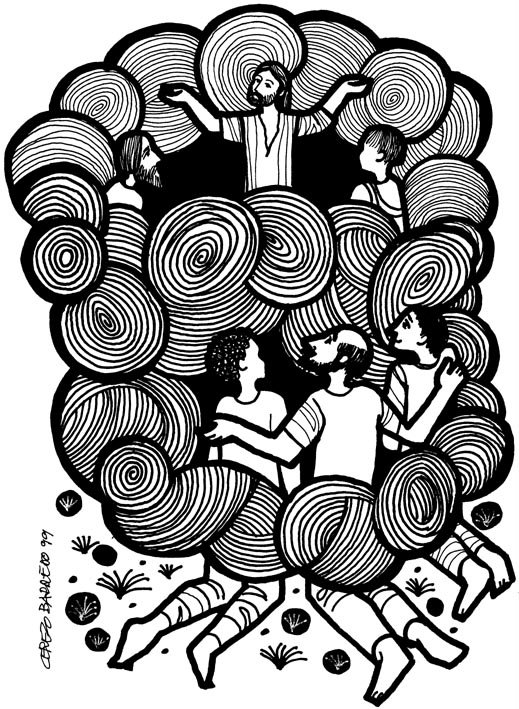
This morning is the last Sunday in Epiphany which we celebrate as Transfiguration Sunday. We just read the story of Jesus going up onto the mountain with Peter and James and John. And up on the mountain Jesus’ appearance is changed and his clothes become dazzling white, such as no one on earth could bleach them. And Elijah, the greatest prophet and Moses, the lawgiver appear with him.

It is an awesome and terrifying experience for the disciples. This person who they knew was suddenly different and surrounded by the two most important persons they knew from scripture.

They thought they saw God in his face. Everything about the experience told them that what they were seeing was extraordinarily sacred stuff. And Peter wanted to build sacred buildings in which to house the things that they were seeing. “Rabbi, it is good for us to be here; let us make three dwellings, one for you, one for Moses and one for Elijah.” He wanted to make temples for them, places of worship to house their appearance.

But before Jesus responds God himself speaks from a cloud saying: “This is my Son, the Beloved listen to him!” And when they look around Jesus is Jesus again.

I’ve always found it interesting that the one thing that God tells the disciples is that they should listen to his beloved son and that the very next thing that Jesus says is not to tell anyone what they saw.

They had just seen the remarkable and Jesus wanted them to keep quiet about it.

The transfiguration is about revelations. Jesus is revealed in all of God’s glory up on the mountain so much so that some theologians believe that this story actually took place after the resurrection.

Jesus is revealed with the two most important characters from the history of the Hebrew Scriptures: Elijah and Moses so that we can see how he is the fulfillment of the law and the prophets.

Jesus is revealed as God’s beloved Son and as the one who God wishes for us to listen to. Jesus is revealed as God’s glory and the disciples are told to not tell anyone what they saw until after the Son of Man is raised from the dead.

I don’t really think it matters much what Jesus looked like, but the fact that Jesus’ face gives the light of knowledge of the glory of God is very important.

Jesus was meant to be God personified; it is why he was given the name Immanuel: God with us.

When God created us he made us in his image, not so that we would look like God, but so that we could be in relationship with God. When Adam and Eve ate the forbidden fruit and were sent out of the garden we lost a piece of God’s image: the piece which allowed us to be with God personified.

But then Jesus was sent to us and God gave us the gift of a new kind of relationship, a second chance, that allowed us to remain as we were (as sinners love by God) but still in relationship with God.

Jesus came so that we could be with God.

Jesus came as a human being with human characteristics and looks so that we could have a relationship with God.

Jesus became human so that we would not have to be like God in order to be with God and what the disciples saw that day up on the mountain was Jesus being revealed as the God who made it possible.

The disciples saw the God of mystery who is veiled to us because of our sin and if Jesus had allowed Peter and James and John to build those dwellings, those holy temples, God would have remained a veiled, unapproachable, untouchable, mystery.

It makes sense that this is the last reading we encounter before the season of Lent when we prepare for the experience of Jesus’ death and resurrection. In it we are shown the glory of God and reminded at the same time that it is in the death and resurrection of Christ that we actually see God’s true light revealed.

It doesn’t matter what Christ looked like, only that his human face was made to return us to relationship with God.

Jesus’ human face returned our hearts to God. Jesus’ human face turned the light of God back on in our dark world of sin. Jesus’ human face revealed to us the true nature of the glory of God: that he is grace and forgiveness and love.

Jesus’ human face reflects the love of God for us in the garden and in the wilderness. Jesus’ human face reflects the love of God for us in the valleys and up on the mountaintops. Jesus’ human face reflects the love of God for us in joys and in sorrows.

Jesus’ human face reflects the love of God for us up on the cross and in the empty tomb.

Jesus’ human face is God revealed to us so that we might be transfigured and made holy, so that we might reflect God’s light to others.

On this last Sunday of Epiphany, the season of light and revelation may you glow with the knowledge of the glory of God’s love.

Amen.

Sunday, February 05, 2006

epiphany 5 yr b february 5, 2006


a sermon based on mark 1 :29-39

In the name of Jesus; amen.

It has been said that the purpose of the gospel is to comfort the afflicted and afflict the comfortable.

Jesus leaves the synagogue on the Sabbath, the day of rest and worship to spend the night at Simon Peter’s house. Once there he is informed that Simon’s mother-in-law is sick in bed with fever. And Jesus goes to her bedside, takes her hand, lifts her up and the fever leaves her.

It might seem to be a small miracle, but what Jesus does is quite big. Simon’s mother-in-law was sick with a fever and a fever in those days could have been a symptom of a serious condition. Infections were often fatal without the antibiotics of today and fevers are symptoms of infection. But even without an infection, this woman could have been sick enough to die. But that’s not what makes what Jesus does big.

What makes this miracle big is what Jesus is willing to do in order to perform it.

In The Gospel of Mark: A Socio-Rhetorical Commentary Ben Witherington III writes:
“Though there are later stories of rabbis taking the hand of another man and healing him, there are no such stories of rabbis doing so for a woman, and especially not for a woman who was not a member of the healer's family. In addition, there is the fact that Jesus performed this act on the Sabbath. Thus, while touching a nonrelated woman was in itself an offense, and touching one that was sick and therefore unclean was doubly so, performing this act on the Sabbath only compounds the social offense. But this is not all.

The service of Peter's mother-in-law to Jesus (and the others) itself could have constituted work on the Sabbath, depending on what was done (.e.g., preparing food). In any case, later Jewish traditions suggest that women should not serve meals to male strangers. The important point about Jesus, however, is that he does not see the touch of a woman, even a sick woman, as any more defiling than the touch of the man with the skin disease. Jesus' attitudes about ritual purity differed from those of many of his fellow Jews.”

What Jesus did broke the rules. In order to cure a woman of a fever he broke laws about working on the Sabbath and ritual purity. And these weren’t little laws, they weren’t minor offenses; they were big deals.

Jesus begins his work of preaching the gospel by comforting the afflicted. He did it in the gospel reading last week by driving out a demon from a man; it’s actually the beginning of this story of Simon’s mother-in-law and occurs on the same day. Jesus begins is work by touching people and bringing them comfort.

And by evening the entire city was gathered around Simon’s home to have demons driven out or sickness cured. It was a long day of work and he went to bed late only to get up early, while it was still dark, in order to go off by himself and pray.

Jesus will do this often in the gospel of Mark; he’ll perform a miracle, become surrounded by crowds of people, then retreat to be by himself. There’s a whole sermon in just that practice; to find time to retreat and pray is essential to Jesus. He practiced what he preached.

But more so than that; he knew that the gospel was about to afflict the comfortable. It was going to make people nervous, uncomfortable, angry. It was going to challenge sensibilities and practices that we as old as time for the society around him.

One of my favorite celebrities ever is Bono, the lead singer for the band, U2. U2 was popular when I was in high school and they have continued to make popular music. I saw them in concert once and remember Bono saying that they weren’t a political band; they were a rock-n-roll band. But Bono has always had a flair for the political from growing up the child of a catholic mother and protestant father in Ireland.

He’s always be active and outspoken about AIDs and poverty and you might remember a song that was released in 1984 called “Do they know it’s Christmas?” It was done by several artists, who called themselves Band Aid, in an attempt to raise money for starving people in Africa. The refrain was, “Feed the world, let them know it’s Christmastime.” Bono’s solo was a simple, but accusing statement: “Well, tonight thank God it’s them, instead of you.”

Recently, at the National Prayer Breakfast, Bono was asked to speak, to offer the sermon for the day, if you will. Jim Wallis, the editor of Sojourners, a religious magazine explains the purpose of the pray breakfast this way:

“The National Prayer Breakfast is normally a time for reaffirming spiritual truths and testifying to the power of faith in people's individual lives, but not so much a moment for prophetic and controversial social utterances.”

But Bono seemed to get the point of the gospel. He seemed to get the point that the gospel is meant to comfort the afflicted and afflict the comfortable. I want to read to you some of what he said:

“Look, whatever thoughts you have about God, who He is or if He exists, most will agree that if there is a God, He has a special place for the poor. In fact, the poor are where God lives.
Check Judaism. Check Islam. Check pretty much anyone.

I mean, God may well be with us in our mansions on the hill. I hope so. He may well be with us as in all manner of controversial stuff. Maybe, maybe not. But the one thing we can all agree, all faiths and ideologies, is that God is with the vulnerable and poor…

It's not a coincidence that in the scriptures, poverty is mentioned more than 2,100 times. It's not an accident. That's a lot of air time, 2,100 mentions. (You know, the only time Christ is judgmental is on the subject of the poor.)”
Bono then went on to speak about how good we are at charity, at giving to the poor, and how that was good news. But then he shared some bad news: “We aren’t very good at justice and equality.”

“Because there's no way we can look at what's happening in Africa and, if we're honest, conclude that deep down, we really accept that Africans are equal to us. Anywhere else in the world, we wouldn't accept it. Look at what happened in South East Asia with the tsunami. 150,000 lives lost to that misnomer of all misnomers, "mother nature." In Africa, 150,000 lives are lost every month. A tsunami every month. And it's a completely avoidable catastrophe.

“It's annoying but justice and equality are mates. Aren't they? Justice always wants to hang out with equality. And equality is a real pain.”

“A number of years ago, I met a wise man who changed my life. In countless ways, large and small, I was always seeking the Lord's blessing. I was saying, you know, I have a new song, look after it…. I have a family, please look after them…. I have this crazy idea...
“And this wise man said: stop.
“He said, stop asking God to bless what you're doing.
“Get involved in what God is doing - because it's already blessed.
“Well, God, as I said, is with the poor. That, I believe, is what God is doing.
“And that is what he's calling us to do.”

Now none of us may have the resources that Bono has; the ability to preach to presidents and reach great crowds of people through his music. And none of us have the abilities to touch a person like Jesus did; to perform miracles of instantaneous healing or exorcism. But we all have the gospel; this amazing message of hope and love and grace.

We are meant to use it. We are meant to tell others about it. We are meant to give it to others whether it comforts them or afflicts them.

May we all be given the voices to do just that.
Amen.

Sunday, January 15, 2006

Epiphany 2 Year B January 15, 2006


Do you see what I see?

A Sermon based upon 1 Corinthians 6:12-20 and John 1: 43-51

In the name of Jesus; amen.

I am a visual learner. This means that in order for me to really learn how to do something I have to be shown how to do it.

If I read it in a book there have to be pictures for me to understand how to do it.

If you want to give me directions to get somewhere don’t tell me write them down and draw a map. Even better… take me there once yourself and I’ll be able to get there later.

I have to see it in order to get it.

When I was a child one of my grandmothers taught me how to crochet. Years ago, on a whim, I decided to pick it back up again as a hobby. So I bought a book on how to crochet. I couldn’t understand the descriptions, but I could follow the pictures.

A few years ago I replaced and rebuilt a toilet all by myself because I could follow the pictures in the Time Life Do-It-Yourself book.

If you show me how to do something there is a good chance I can do it.

I am a visual learner, but if you really want me to be able to do something well: show me how to do it then let me try while you talk me through it, show me what I did wrong, then let me do it.

A dear friend got married several years ago at another friend’s house. Somehow I was recruited to help make 50,000 white bows and the men’s boutonnières for the ceremony at about 1:00am the night before. Michael had me watch him make a bow then I tried and he critiqued me as I did it.

It was that late night that taught me that if I want to really know how to do something I have to see it done then try it myself with someone there to show me what I’m doing right and what I’m doing wrong.

Most people are visual learners. This means that in order to learn we need to see it being done and then we need to be watched as we try it ourselves.

There are things I can figure out on my own, even things I can do well by making up the directions… but I had to be shown how to make my mother’s fudge before I could make real fudge. I had to be shown how to tie my shoes, pump my own gas, read a map, turn on a computer and then use it before I could do those things.

I am a visual learner. But not everything that I have been shown has taught me good things. In ninth grade my friend Erica showed me how to French inhale a cigarette. Not everything I’ve been shown, by others, has been for the best for me.

I have learned some pretty awful things by what I’ve been shown, by seeing what others do and then following their example. It’s made me careful as to what I show others.

Jesus had decided to go to Galilee and there he met up with Philip and invited him to become a disciple. Now this made some impression on Philip and so Philip found his friend Nathanael and told him about Jesus. But Nathanael was skeptical: “Can anything good come out of Nazareth?”

And Philip’s response: “Come and see.”

Nathanael was a visual learner too. Philip had knowledge; important, useful knowledge and the only way he could teach his friend was to show him. Philip could have just decided to let Nathanael figure it out on his own, but instead he made an invitation to teach Nathanael.

And because Philip showed him Jesus, Nathanael was able to see, in Jesus’ own words, “greater things than these.”

It stands to reason that if we can learn by being shown that we can teach others by showing them.

This means two things to me: First, that we make the invitation to come and see. If we know something, something as important and life-changing as God’s love then we should make certain to invite others to be witnesses to it. Information like we have isn’t supposed to remain secret it’s supposed to be shared so that others know it too.

And this is knowledge that is taught by what is shown. All the theological books in the world can’t teach a person about God’s amazing grace the way it can be taught through the actions of coming in contact with God’s people.

And that’s the second thing. As God’s people we should show others the best of ourselves. And that doesn’t mean that we should fake it when we aren’t feeling our best or that we can’t make mistakes. But that it’s important to do things that are good and to do them not so we get praised for doing them, but so others can see good and want to learn how to do good too.

It means that people learn about God’s love for them from how we show love to others and how we present ourselves.

St Paul writes about how we should use our bodies in the second lesson today. Until now I couldn’t see the connection between that reading and the Gospel. But it is there.

How we use the bodies that God gave us also shows others what it means to be loved by God. Paul focuses on fornication, having sex with lots of people. But how we use the gifts that God has given us in our own selves goes beyond who we sleep with. It’s also about how often we put ourselves down on our knees and pray. It’s about how we put ourselves physically in other people’s lives through the time we spend with them and the time we give to them.

Other people see this. They see what we show them and what we show them should be about God’s love and God’s grace.

We don’t need to convert people, or judge others, or tell them what they should do. This isn’t the way to show others God.

Showing others God is living a life that is focused on God and God’s desires for us and doing that will be an example for others.

And then it means living with them as they struggle to figure it out.

Invite others to come and see and then give them something to see: that’s God’s love through Christ is a blessing and a miracle and a vision of great things.

Amen.

Monday, January 09, 2006

Epiphany / The Baptism of our Lord

A Sermon for Epiphany and The Baptism of Our Lord Year B 2006 based upon:
Matthew 2:9-12 and Mark1:4-11


In the name of Jesus; amen.

I received a really great gift from my husband for Christmas this year: a paraffin wax bath. Now for those of you who don’t know what that is, it’s a pot that looks a little like an oval shaped crock pot. You put paraffin wax inside and melt it then you dip your hands or feet inside until they have about 5 coats of wax on them. Then you place your hands in a plastic bag and cover them with warm mitts and wait until the wax solidifies and remove it.

The idea is that the wax has oils in it that soften your skin and make it feel like new. It is exactly what I asked for; I even pointed it out to my husband and told him that was what I wanted.

It’s one of those things that makes me glad I am a girl. It’s a wonderful experience, luxurious, and soothing. But it has personal and practical applications for me as well. In the winter-time the skin on my hands becomes very dry; it cracks and bleeds if I’m not careful, so while it seems like it’s a luxury it also helps my hands.

Mary and Joseph had found their way from the cave they had been in to a home in which to stay in Bethlehem with their new baby boy. They were trying to settle in when astrologers showed up at their door with gifts for the baby. Tradition calls them magi and kings, but they were astrologers who had seen a sign in the stars. Tradition also says that there were three, but there could have only been two or even more than three.

The gifts that they brought were extravagant; gifts meant for a king: gold, frankincense, and myrrh. You gave gold to a king and anointed him with oils made with frankincense and myrrh. Mary and Joseph must have been surprised to be part of that baby shower.

Of course the gifts were extravagant; they were symbols of the baby’s kingship and it would have made anyone glad to be a king to receive such gifts.

But the gifts had a practical purpose as well. While gold, frankincense, and myrrh were symbolic they also provided financial stability to this new family because shortly after giving the baby these gifts the magi and Joseph were informed, through their dreams, that Jesus was in danger and the family had to flee to Egypt.

These gifts would have given them the means to travel and then make a home in a new place.

I like gifts that are extravagant, but when they are extravagant and serve a practical purpose… ooh… those are the best.

There’s a lesson here about gifts and the giving of them. How many of the gifts you received this year for Christmas are already broken or put away never to come out of storage again? One year my mother-in-law gave me a waffle iron for Christmas. I loved it; I even used it, but it’s been on one shelf or another collecting dust for some time now.

The gifts that have the most meaning are usually the ones that we wear all the time or that we take out and use on a regular basis.

I intend to put my paraffin wax bath to great use; I might even take it out later today.


We entered into the season of Epiphany two days ago; the season we remember the coming of the magi and their purposeful and extravagant gifts only to come to this Sunday’s Gospel reading of Jesus’ baptism. I don’t think there should be any mistaking the connection. Jesus’ baptism is a gift; an extravagant and purposeful gift. In Mark’s gospel Jesus’ baptism is the beginning of the story of what God has gifted to us.

At face value it might not seem extravagant, but there’s John the eccentric cousin to Jesus, out in the wilderness wearing funny clothes and eating strange food wading out into the Jordan River with Jesus, pouring water over him in an act that prompts God to tear open the heavens and come down in the form of a dove like a prophecy come true.

That’s pretty extravagant… something that doesn’t happen all the time, something excessive, something out of the ordinary.

And with Jesus’ baptism comes his ministry and with his ministry comes his teaching and healing, and with that comes the gift of his very life, an act that doesn’t simply fulfill our needs but actually changes our needs and then fulfills them.

Jesus’ baptism is an extravagant gift because it drives him into the wilderness and into our lives and our wildernesses. It’s excessive, to say the least, that God would go to such lengths and yet it is necessary and purposeful.

Jesus’ baptism becomes a connection to us in our baptisms, another gift of God, which makes us children of God. And in that way we are given another connection to Jesus in his death and resurrection.

And that is purposeful, useful, necessary for us because it means our salvation and because it means life with God.

Our baptism is an extravagant purposeful gift that God went to extremes to make sure we received. And like Joseph and Mary used the gifts of the magi to finance their flight to Egypt we are meant to use the gift that we’ve been given to finance our lives.

We aren’t supposed to put baptism up on a shelf and say things like: “Oh yes, I got that years ago but I only take it out for special occasions like Christmas or Easter.” Or “Oh I really do like it; I just never get a chance to use it.”

Baptism is meant to be practical, to be used every day, put on and worn even when company isn’t around.

Epiphany is supposed to be the season of light; the time of God’s light revealed to us.

In baptism we are given a part of that light: a part of that star that shone and led the magi to the baby Jesus and a part of Jesus himself. And once given that light we are called to let it shine so that others might be led to the place where Jesus is and then realize the light that has been given to them.

It is a gift that we have been given so that we can give it to others.

May your light so shine, in this season of Epiphany and throughout your lives, that others might see your love for Christ, and give glory to God in Heaven.

Amen

Sunday, November 06, 2005

All Saint's Sunday Year A 2005


Sainted by Baptism; a sermon based upon Revelation 7:9-17

In the name of Jesus; amen.

For the last several weeks we have been talking a lot about the future of this church so today I want to talk to you about the present of this church. Our first reading is from the book of Revelation. Most people today think of Revelation as a code to predicting the future, but what the writer of Revelation is really speaking about is a present reality.

If you try to interpret Revelation as what will happen, as movie makers have done for years, you will miss its meaning. Revelation is the story of the Church. It’s filled with conflict, confusion, and attack, but even in the worst of it we still cry out: “Salvation belongs to our God who is seated on the throne, and to the Lamb!”

Even in the worst of it all the angels and the elders, and the creatures, and the multitudes from every nation, tribe, and language sing out to God: “Amen! Blessing and glory and wisdom, and thanksgiving and honor and power and might be to our God forever and ever! Amen.”

Revelation is the story of the Church and as such it is our story: filled with conflict, confusion, and attacks but also words of comfort and reasons for singing about the glory of God.

To be honest, the book of Revelation scares me a bit. Martin Luther said it was one of the books of the Bible he would have left out because it was too confusing and distracted from understanding the Gospel. But this passage… well, it makes the rest of the book worth it to me.

Exiled from his home, the writer (who was possibly named John), imagines a great multitude of people, more than anyone could count, all different, standing before God. And they are there, not to be judged, but to worship. I call it the great inclusion: everyone, all people robed in white, washed clean, and worshipping God.

And they aren’t alone; because there are the angels, and the elders, and mystical beasts worshipping right along with them. It’s a crazy picture filled with all the colors of creation and blazing white.

And there they are, because they’ve been washed in the blood of the lamb; all there because they’ve been joined together through the baptism of Christ’s death and resurrection.

And then the great inclusion becomes the great exclusion because God begins to take away all those things that torment and cause conflict: no more hunger, no more thirst, no more scorching heat or sun that strikes and God becomes a shelter and a tissue to wipe away all tears.

This is the story of the Church and it is our story. It is the story of the saints; the story of us because we are the saints the ones whom God as called to worship.
And man, is it beautiful and comforting and filled with such grace. And I don’t know not one of us who doesn’t need this story. I don’t know one person who doesn’t need to have a story of beauty and comfort and grace like this one.

The festival that we are celebrating today is actually a pagan festival that included rituals to ward off the dead. The church claimed it long ago as the festival of the saints in its attempts to convert pagans to Christianity. It’s why we remember all those who have died.

But the festival of All Saints is really about baptism. That incredible thing that includes us in all the promises of God. Baptism includes us in a present reality of what God has intended for us. It’s not some future thing, but a right now thing. Baptism isn’t just something that took place in our individual pasts, but a thing that takes place in us each and every day… because God’s promises are for each and every day.

They aren’t just promises for special people or people who appear to be deserving of special attention. Baptism has included us in the picture that John paints of the great inclusion where we stand in front of God in worship with a multitude so great it can not be counted.

This is our present reality. God is on his throne and we are in worship.

Yes, there is conflict and confusion and attack in our present reality… but God has built a shelter for us where we can be fed and not fear the heat and have our tears wiped from our eyes.

This is our present reality because God acted in our past and because God has secured our future for us. God is here in the now listening to our prayers and our supplications and our praise so let’s give it.

Let us stand together under God’s shelter.
Let us eat and drink the meal that God has prepared for us.
Let us feel refreshed from the cool warmth that God has provided.
Let us follow the Lamb whose blood washed us clean.
Let us swim in the spring of the water of life.
Let us offer our tears to be wiped away…

And let us sing out Amen, amen, amen.

Sunday, October 23, 2005

Pentecost 23Year A 2005


people i don't like.

Matthew 22:34-40
34 When the Pharisees heard that he had silenced the Sadducees, they gathered together, 35 and one of them, a lawyer, asked him a question to test him. 36 "Teacher, which commandment in the law is the greatest?" 37 He said to him, " "You shall love the Lord your God with all your heart, and with all your soul, and with all your mind.' 38 This is the greatest and first commandment. 39 And a second is like it: "You shall love your neighbor as yourself.' 40 On these two commandments hang all the law and the prophets."

There are just some people that I don’t like.

I don’t like people who don’t use turn signals. I was discussing this with a friend just yesterday. Turn signals aren’t to remind you that you are turning, but to let me know that you are turning so that I don’t cause an accident.

Which reminds me of a whole other group of people that I don’t like: bad drivers. Oh sure, I make mistakes when driving, I’m only human you know. But there are some people who are bad drivers… and I don’t like them.

Ever driven in Boston? Boston drivers are almost as bad as Florida drivers, who I have little fondness for. The roads in Boston are built over old cow paths. Now cows are not the smartest of creatures, they are delicious, but not good city planners. And there again… people who design roadways. I don’t like them either. The other day I had to go to Worcester (which is either pronounced wrong or spelt wrong) and coming home I missed the exit for 84 and had to drive 30 minutes out of my way. Whoever decided not to put one more exit in between… I don’t like them either.

And I sure didn’t like the person who wouldn’t let me merge into traffic the other day, he even honked his horn at me when I was forced to cut ahead of him… as if he owned the road.

And I don’t like mean people. You know what I’m talking about, people who just can’t be pleasant and seem to find excuses to make your life miserable. Ugh, I just can’t stand them. They are almost as bad as people who won’t shut up. I do not like people who will not give me a chance to speak. My opinion counts too, I should be allowed to verbalize it shouldn’t I? But no, they just blah, blah, blah, blah, blah as if they are the only ones who have something going on in their lives worth discussing.

And then there are people who talk too loud on cell phones in public places about personal issues. Those people drive me crazy. Go outside to speak to your girlfriend about the intimate personal details of your date last night.

There are just some people I don’t like.

I don’t like people who smell. You know who smell? Foreigners. And I’ll be honest, I don’t like people with thick accents. Can’t understand them!

And you know who I really can’t stand? Closed-minded people. They are so judgmental… as if they’ve never made a mistake in their own lives. I don’t like republicans. Just look at how they treat the poor (and don’t even get me started on the poor). Don’t like Democrats either. Most of them are morally deprived. I’d register Independent, but I don’t like Independents either. I mean, who do you think they are?

I can trust you all with this right? Because people who can’t keep secrets… don’t like them. Gossipers are the worst aren’t they?

And I know that I wasn’t going to talk about poor people, but I’m tired of hearing about them. I have my own money problems. I don’t really need to be reminded of theirs all the time. What, am I supposed to feel guilty because I have things other people don’t?

There are just some people I don’t like. I don’t like people who don’t like chocolate. Even if you are a diabetic, they have sugar-free chocolate… eat it, it’s good. What are you on a diet? Because skinny people, don’t like them almost as much as I don’t like fat people.

And then there are black people, now don’t get me wrong, I have black friends… I know black people, but there are black people…I just don’t like. Gay people too; I am sick and tired of hearing how oppressed those people are. I just don’t like them.

But then white people are the worst, especially Americans. They think they own everything. After all it’s the Jews who own everything and I don’t like them either. Which reminds me if you put a dot on your forehead or wear a scarf over your head… don’t even try to gain my favor.

There are just some people who I don’t like. I don’t like conservatives. They act as if I have to agree with everything they say or I’m going straight to hell. And liberals…they think they are going to save the world when really they have no sense of right or wrong. Don’t like moderates either… I just can’t like people who aren’t willing to take a stand one way or the other.

There are just some people I don’t like.

I don’t like people who drive SUV’s. I know that I have one, but I need it. Don’t people realize that the world’s resources are being sucked up by those vehicles? But then there are the environmentalists. Don’t those people ever give it a rest? I just don’t like people who try to make me feel guilty for forgetting to recycle.

And then there are the people who tell me that I’m supposed to love everyone… is there anyone who I can like less?

Love, love, love… how am I supposed to love people I don’t even like? I’m a nice enough person to get along with; but love my neighbors! I live next to a church for crying out loud… how am I supposed to love those people?

Whoever came up with that must have been a nut case. Lord knows I don’t like crazy people.

Yup, there are just some people I don’t like.

Sunday, October 16, 2005

Pentecost 22 Year A 2005


Whose Image is on You?

A Sermon on Matthew 22:15-22 with thanks to the exegetical notes of Brian P Stoffregen for Proper 24A.

In the name of Jesus; amen.

In 1789, Benjamin Franklin wrote in a letter to a friend, "In this world nothing is certain but death and taxes." Nearly 150 years later (1936), Margaret Mitchell used a similar phrase in Gone with the Wind: "Death and taxes and childbirth! There's never any convenient time for any of them."

Nothing is more real life than taxes. They happen to all of us whether or not we want them too. Even if you cheat on your income tax or refuse to pay it there is still sales tax. Taxes just happen.

Today Jesus is asked a question about taxes, but the taxes in our Gospel are nothing like any of the taxes we pay today-- not income, property, or sales tax. We know few details about this tax, other than it consisted of a flat-rate personal tax on all men from age fourteen and women from age twelve to age sixty-five and was levied at least at the rate of one denarius (about a day's wage) per year. Later (we do not know when) it was combined with a percentage tax on property.

While most are resigned to paying our taxes we should remember that the lives of Jews living in the Roman Empire at the time of Jesus or Matthew was nothing like living in America in the 20th century. Their God-given homeland was under foreign occupation.

For Jews and then the Christians, the annual payment of this particular tax to Rome was a painful reminder of living in an occupied country by foreign powers who worshiped false gods. The tax could only be paid with Roman coins which were not just legal tender but also pieces of propaganda. Most of the coins contained an image of the Caesar with inscriptions proclaiming him to be divine or the son of a god. "Graven images" and polytheism were blasphemous to both Jews and Christians. Thus paying taxes with Roman coins raised both political and religious issues.

Every time they pulled out their money, they would be reminded that their enemy was in power. Every time the Jews used Roman money, they were reminded that they were occupied and that the emperor was making himself another god.

15 Then the Pharisees went and plotted to entrap him in what he said. 16 So they sent their disciples to him, along with the Herodians, saying, "Teacher, we know that you are sincere, and teach the way of God in accordance with truth, and show deference to no one; for you do not regard people with partiality. 17 Tell us, then, what you think. Is it lawful to pay taxes to the emperor, or not?"

The Pharisees had a good plan to entrap Jesus. Taxes were a serious issue in that time. While we may complain about the cost of a tax; for the people of Jesus’ and Matthew’s time the tax was about their belief and their sense of religious morals. It was about their whole sense of who they were as a people of God.

If Jesus had said that it was lawful to pay the tax the people would have seen him as being in league with the enemy. But if he had said that it was unlawful he would have been in deep trouble with the enemy.

So Jesus asks for a denarius, which is clever in and of itself because now the disciples of the Pharisees (who would have opposed the tax) and the Herodians (who would have supported it) had to provide the very coin that was in despute.

“Whose head is this, and whose title?” he asks. Well, it was Caesar’s. “Give therefore to the emperor the things that are the emperor’s, and to God the things that are God’s.”

How do we know what things belong to Caesar? Well, they have his image on them! Just like all governments put their mark or image on their country’s money.

And how do we know what things belong to God? Well, they have God's image on them too!

What are we to give to God? The things stamped with God's image -- us! We are to give God ourselves -- our whole selves -- not just some part.

Some may give God their minds,but have hearts far from God.Some may give God their hearts,but are unwilling to learn from God in the WordSome may give God their muscles,but are unwilling to bring their bodies to worship or education classes.Many give God 1 or 2 hours a week,but God wants all 168 hours a week.Many give God 2% of their income, perhaps think about 10%but God wants 100%.

We cannot say that "this part belongs to God, so I will give it to God." Everything we are and everything we have belongs to God. Everything we are and everything we have we are to give (back) to God. We are but mere managers or stewards of these gifts God has given to us.

Properly managing the money God has given us means some of it is to go to the government. Sorry folks we are to pay our taxes even when we think they are too much or don’t like how they are being spent.

Properly managing the money God has given us means spending wisely and paying our bills. Properly managing the money God has given us means saving some of it so that we have what we need when needs arise.

But properly managing the money God has given us also means remembering that it is not ours, but only what God has given us.

This morning our worship is about healing and this afternoon at the St Francis celebration to bless the animals worship is about giving thanks to God for the gift of creation. There is a theme today of God giving us wholeness but to get it (and I don’t mean “get” in terms of receiving, but in terms of understanding) we have to remember that we belong to God. We are God’s.

Not just parts of us, but all of us. Not just on Sunday mornings, but all week long. Not just while we are praying, but in everything we say and do. Not just in the money we put in the offering plate, but in ever cent we save or spend.

We are God’s 100% all the time. We have been marked with the image of God… let’s live it.

Amen.

Saturday, October 08, 2005

Pentecost 21 Year A 2005


A Sermon based upon Matthew 22:1-14

In the name of Jesus; amen.

Over the last few weeks we have been focusing on our mission statement. Here it is again: Our Mission is to Proclaim Christ through Worship, Fellowship, and Caring for our Neighbor. This Mission will specifically focus on ministry to Families, Children and youth, and the Poor.

Last week we distributed Financial Commitment Cards in order that we could have the opportunity to commit to this mission through giving of our treasures. This week the Stewardship Committee is asking us to consider supporting our mission through the giving of our time.

To help us they have come up with Time Commitment Sheets for us to fill out so that we know what ways people are willing to serve through the gift of their time.

It’s fitting with today’s gospel: Jesus’ parable of the Wedding Banquet. In the parable there is a King who’s son is being married. Now I have been to some pretty fancy weddings in my day, but weddings that took place in Jesus’ day were amazing spectacles. They could last for days, everyone was invited, wine flowed, there was food aplenty… families would spend everything they had in order to impress the guests.

So one might imagine that a wedding thrown by royalty would have been exceptional… a thing not to be missed under any circumstances. The food would have been the best, the wine would have been the best, the entertainment would have been the best. Anybody who was anybody would have been there.

It would have been a party that no one would want to miss.

Now, last week I told you that parables were stories that Jesus used to explain something about God or the kingdom of God. They weren’t meant to be true to life stories, but stories that taught us something about how God operates.

Once more Jesus spoke to them in parables, saying: “The Kingdom of Heaven may be compared to a king who gave a wedding banquet for his son.” And like any proud parent whose child is about to be married he sent out invitations: Mr. and Mrs. King request the honour of your presence at the marriage of their Son, the Prince to Miss Princess etc… etc…”

One might imagine that getting such an invitation would be a great honor, a reason to celebrate and go shopping for the appropriate attire and china patterns. But in Jesus’ story those invited don’t even RSVP; they simply go about their day and when servants are dispatched by the king to find out why no one is coming some of the invitees make fun of the situation and go about their business while others mistreat the servants to death.

Now if you have ever thrown a party that no one has shown up for you can imagine that the King must have been pretty upset and he was. In fact he’s so upset that he sends in his troops and once the original guests to be are properly dealt with he makes a decision. He decides that they weren’t worthy of such an honor as coming to his son’s wedding celebration and sends his servants out into the streets to bring back whoever they can find to celebrate his joy.

So the servants go out and bring back everyone they can find both good and bad and the wedding banquet takes place.

It’s a funny thing, but I often have the hardest time preaching on what might seem to be clear-cut passages from scripture. Up until this point the story seems rather easy to figure out. God is the King in the story and the wedding is a metaphor for faith is his son. The invitation is given to those that God expects will most want to celebrate Jesus’ message of love only to discover that they don’t wanna, they’d rather go about doing what they always do.

So God invites others, people who might not look worthy on the outside, but who are willing to accept the invitation and come to the party.

And what makes this hard to preach is that you all have shown up. You are here. You’ve come to the party! Somewhere along the line you got the invitation and decided that this was where you wanted to be, or at least where you were willing to be today. Parables like this I want to preach to the people that aren’t here.

But then, Jesus’ parable isn’t over is it? The King decides to do some smoozing with his guests only to discover that one of them isn’t dressed in a wedding robe.

Now this part of the parable isn’t cut and dry. According to tradition people attending a wedding always wore their best clothes, even if they were very poor and had to borrow clothes dressing for a wedding was a must. Wedding robes were not everyday clothes… they were special.

And even if you remember the days gone by when everyone had their Sunday best that they put on once a week to attend church… this is not a parable about proper attire or looking pretty. Wearing a wedding robe was a symbol of honoring your guest by giving him or her your best.

If the first group of invitees dishonored the King by not accepting their invitations then this one guest dishonored his king by not putting on the best he had.

It’s not enough to just show up whether you are wearing sneakers or heels, jeans or a suit. Just like it’s not enough to just say that you are a Christian, you also have to live like one.

The first people invited to the wedding banquet didn’t want to go. They were offered a great opportunity to sit at a king’s feast. But the one who didn’t wear a wedding robe at the banquet didn’t want to be there. And they missed it; they missed their chance to celebrate with God.

Coming to church on Sunday mornings is wonderful, but if you go home Sunday afternoon and think that’s all God wanted from me, you’re wrong. The wedding banquet that God has invited us to is life-long and daily.

The invitation is free, but what good is a party you do nothing at? God wants us to be at the party and to dance and sing to eat and drink and be a part of it.

And in case you wanted to know what the party looks like, Isaiah gives a pretty accurate description:

6On this mountain the LORD of hosts will make for all peoples a feast of rich food, a feast of well-aged wines, of rich food filled with marrow, of well-aged wines strained clear. 7And he will destroy on this mountain the shroud that is cast over all peoples, the sheet that is spread over all nations; 8he will swallow up death forever. Then the Lord GOD will wipe away the tears from all faces, and the disgrace of his people he will take away from all the earth, for the LORD has spoken. 9It will be said on that day, Lo, this is our God; we have waited for him, so that he might save us. This is the LORD for whom we have waited; let us be glad and rejoice in his salvation. (Isaiah 25: 6-9)

Here we are… let’s live the gift that God has given us.

Amen.

Sunday, October 02, 2005

Sermon for Pentecost 20 Year A


Matthew 21:33-46

In the name of Jesus; amen.

We often want what isn’t ours. In the parable that Jesus tells a landowner hires tenants to care for his vineyard. When harvest time comes the landowner sends his servants to collect what is his, but instead of the tenants handing over the produce the landowner expected they killed the servants he sent.

So the landowner sends even more servants and again the tenants kill them. So the landowner makes a radical decision: he sends his own son to the tenants to claim what is rightfully his. When the tenants see the landowner’s son they too make a radical decision and seize the son, throw him out of the vineyard and kill him so that they can claim the son’s inheritance.

Now parables were Jesus’ way of telling a story about God or the Kingdom of God. It’s important to remember that because often times Jesus’ parables can seem outlandish.

What parent would send their child into what all the rest of us would see as such a dangerous situation? Today we would send in the Marines to deal with people like these tenants. Jesus’ landowner looks like a fool to act the way he did. But parables weren’t meant to be taken as literal stories. They were meant to teach us something about God.

We should see God as the landowner in this parable. God who created the world just as the landowner made his vineyard. If parables are meant to teach us about God and God’s kingdom then what does this parable teach us about God?

Jesus tells this parable to a specific audience who would have been familiar with vineyards and the idea of hiring tenants to work them. At the end of the gospel reading the chief priests and the Pharisees get upset because they figure out that Jesus is likening them to the tenants.

In Jesus’ story the landowner is willing to try over and over again to give the tenants a chance to do what is right and in the process he suffers great loss. Jesus asks his audience to finish the story for him: “Now when the owner of the vineyard comes, what will he do to those tenants?” And the people give their answer: “He will put those wretches to a miserable death, and lease the vineyard to other tenants who will give him the produce at the harvest time.”

It’s no wonder the chief priests and Pharisees are upset when they hear the parable.

But the truth is that this parable should make us all feel uncomfortable. The tenants were entrusted with the care of the vineyard, but instead of honoring the deal that was made between them and the landowner they seek to break it by keeping what wasn’t theirs. And in the end they go so far as to kill the heir so that they can claim the land for themselves.

It wasn’t hard for the tenants to begin to believe that the vineyard was actually theirs. We all do it.

The culture we live in uses ownership as a means to place value on a person. The more we have the more worth society places on us.

Much has been made of the looters in New Orleans after Hurricane Katrina ripped through parts of Texas and Louisiana. Most people I’ve talked to have agreed that it was ok for people to break into stores to take food and supplies they needed, but not to take things like TVs and stereos. There wasn’t even electricity so what would a person need with a big screen TV?

But while it was wrong for people to do it, I understand the mentality. Many of those looters had little before the hurricane took everything. In a society that teaches that having something makes them worthwhile they seized an opportunity to have something they never had before. We see it all the time. And not so long ago we saw it happen with rich people too… remember Enron? They knew it was wrong to cheat people out of their savings and yet… they wanted what wasn’t theirs in order to claim status that didn’t belong to them.

I can see how these tenants would have desired the land that wasn’t theirs. But more importantly I can see how they would have thought little of going to great lengths to acquire it.

The looters saw large screen TVs and didn’t think: there’s no electricity I don’t need this; they thought OWNERSHIP.

The tenants saw the vineyard and didn’t think: well this doesn’t belong to us; they thought OWNERSHIP.

They believed the lie that ownership means power and status.

But the landowner saw it differently. The landowner saw what he had and gave it to others. The tenants were given a place to live and work to do. They were given what they needed. The landowner entrusted those tenants with all he had so that they could live.

Now Jesus was talking about faith when he told this parable. In simplest terms: the landowner is God, the slaves were the prophets, the son was Jesus, and the tenants were those who claimed they owned the faith: the religious leaders.

It might be easy to turn this into an anti-Jewish story by saying that the Jews didn’t accept the prophets or Jesus; but we must be careful not to lay claims like that on this story or we miss the point.

God is clearly the landowner and Jesus is his son, but we have to be careful not to forget that we are the tenants. The story of God’s grace is not for us to hoard, but to share and return back to God.

Now I’m hoping that you’ve made another obvious connection to Jesus’ parable. The vineyard is also the world in which we live and it has been given to us by God to care for it.

It’s clear that we owe something back to God. While salvation is only through God’s grace, Jesus in the Gospel of Matthew, expects something of those to whom grace has been given in the gift of God’s kingdom.

We are expected to live under God’s authority; to produce and give back the proper fruit. Not because we will be thrown out of the vineyard if we don’t; but because we’ve been given the gift and the responsibility of caring for God’s kingdom.

And that is good news. God has entrusted the kingdom to us for all that we need out of his love for us. Grace has been given to us and will not be taken away because of Jesus’ gift of his death. Now it is time to produce the fruit of that love and return it to God.

Amen.

Tuesday, September 06, 2005

Pentecost 16 Year A 9/4/2005

Sermon based upon Romans 13:8-10 and the Theme: Mission

In the name of Jesus; amen.

“Owe no one anything, except to love one another; for the one who loves another has fulfilled the law. The commandments ‘You shall not commit adultery; You shall not murder; You shall not steal; You shall not covet’; and any other commandment, are summed up in this word, ‘Love your neighbor as yourself.’ Love does no wrong to a neighbor; therefore, love is the fulfilling of the law.” Romans 13:8-10.

September has been designated “Salem Mission Month” by the Stewardship Committee. They have asked that we take time over the next four Sundays to talk about our mission as a congregation. Our hope is to have some conversations about what we believe our mission is and then formulate a new simple and concise mission statement.

Typically this time of year the thoughts of most stewardship committees in most churches turns to the issue of pledging and how to get their members to commit to giving money to the church. I’d say most people dread this time of the church year. I’ve even heard of a congregation that called the day members were asked to make pledges: “Black Sunday.”

Stewardship for many people means being asked to give money so that bills can be paid and the church will survive. But that’s not the point of stewardship at all. Stewardship is caring for the gifts that God has given to us. It means seeing that God has entrusted the world to our care and then caring for it.

Stewardship isn’t about money; it’s about faith.

So, last week I asked you to think about what you were passionate about. What was important to you? What would you fight for? What gave your life meaning?

And last Sunday hurricane Katrina hit Louisiana. It wasn’t bad at first, but then the levies broke and the city of New Orleans was destroyed leaving its inhabitants homeless and worse.

If you are like me, watching the footage on TV and reading the stories of what’s taking place there… it puts things into perspective doesn’t it?

So, I’m going to ask for you all to find a partner and spend just a few minutes sharing the things that you are thankful for…

… so what were some of the things you all came up with?

I would bet that the things that you are grateful for are also the things that you are passionate about, that are important to you, that you would fight for.

As we talk about our mission as a congregation it’s important that we consider the things that are important to us, that mean something to us, that we are passionate about as a congregation.

Paul writes: “Owe no one anything, except to love one another; for the one who loves another has fulfilled the law. The commandments ‘You shall not commit adultery; You shall not murder; You shall not steal; You shall not covet’; and any other commandment, are summed up in this word, ‘Love your neighbor as yourself.’ Love does no wrong to a neighbor; therefore, love is the fulfilling of the law.”

Understanding our mission is part one of knowing how to love our neighbor and fulfill our purpose as God’s people.

Yes, the stewardship committee is still going to ask people to make a pledge, but more so than making a pledge, we want to find ways to support ministry that means something to us.

So here’s your homework for this week:

Begin to think about the strengths of this congregation. What are we good at? What makes us who we are as people of faith? This will be the first step in our process of creating a new mission statement and a new direction in how we can serve God and our neighbor.

Saturday, August 27, 2005

Pentecost 15 Year A 8/28/05

A Holy Identity

Sermon based upon Matthew 16: 21-28

In the name of Jesus. Amen.

Peter must have been on some high. Jesus had just given the disciples a pop quiz on who the Son of God was and Peter had gotten the answer right.

“You are the Messiah, the Son of the living God.” Peter told Jesus.

And Jesus gave him the gold star of all time: he called Peter the rock on which the Church would be built and then he gave him the keys to the kingdom of heaven.

Peter must have thought he was hot stuff. Can you imagine him holding his head high, giving the other 11 that look of superiority that screamed “teacher’s pet”?

But just as Peter was really getting comfortable basking in the glow of his new office, Jesus began to talk about going to Jerusalem and being arrested, tortured, and executed. It must have taken a moment for it all to sink into Peter’s swelled head. Surely Jesus didn’t know what he was saying. He was the Son of the living God. And if this was what was going to happen to Jesus, what would happen to the man that held the keys?

And in his newfound arrogance Peter walked up to Jesus and told him to zip it. “God forbid it, Lord! This must never happen to you!”

Jesus dying at the hands of the elders and the chief priests and the scribes wasn’t exactly what Peter had in mind when Jesus gave him his new titles as the cornerstone of the Church and the gatekeeper of heaven. And it certainly didn’t fit in with his understanding of what it meant to be the Son of the living God.

Back in high school I remember taking algebra tests. On the test you always had to show the work you did in order to reach your answer. And if you got part of the work wrong you had points taken off even if the answer was correct.

Well, the same held true for Peter. He had gotten the answer right when Jesus asked him, “Who do you say that I am?” But his work was all wrong. He had come to his answer through faulty math. And Jesus took off some points for his work.

“Get behind me, Satan! You are a stumbling block to me; for you are setting your mind not on divine things but on human things.”

Peter might have known that Jesus was the Messiah, but he had no concept of just what the Messiah was.

It was not about status or power. Being the Messiah did not have perks that came with the job. In fact, the opposite seemed to be true. Being the Messiah, the Son of the living God meant that Jesus was to be a sacrifice.

Last Sunday, when Peter made his confession that Jesus was the Messiah I told you that his confession of who Jesus was also defined who Peter was. When Peter says that Jesus is the Messiah Jesus tells Peter that he is the rock. And then I asked you what you had become because of your confession of who Jesus is. But this week, Jesus complicates that identification by injecting the cross into the equation.

Like Peter, we often get the final answer of who Jesus is through faulty math and that means that we miss the point of who we are supposed to be.

Jesus says this: “If any want to become my followers, let them deny themselves and take up their cross and follow me. For those who want to save their life will lose it, and those who lose their life for my sake will find it.”

Being a Christian isn’t easy work, it comes with sacrifices which begin by allowing Jesus to be the one who defines us.

We spend much of our lives being defines by others. The world defines us in its own way too… and usually with those definitions of our identities come slanted views of who we really are. The world defines us by human things: what we look like, how much money we make, what our social class is, what our physical abilities are, who we have as friends, our jobs, our cars, and on and on…

But Jesus defines us by divine things. Jesus looks at us through the eyes of grace and sees our actual worth. Jesus looks at us from the cross and that makes us precious things of great value to him. It is because of his sacrifice that he knows how dear we are and it is because of how dear we are that he makes that sacrifice.

Peter had the right answer; he called Jesus the Messiah, the Son of the living God, but he used human terms to define what the Messiah was and he got it all wrong.

The same goes for those of us who wish to be followers of Jesus. Because following Jesus means setting aside human understandings of value and seeing value in seemingly worthless things. It means letting God choose for us what things have value; it means letting God place each one of us on the paths that we are meant to be on, rather than following what the world tells us we are or what we are supposed to be.

During the month of September we are going to be talking about mission. But in order to do that we have to answer some questions. In order to understand our mission as a congregation and as individuals in it we will have to answer Jesus’ question: “Who do you say that I am?” We will have to answer the question of who we are and the question of what the world is around us.

So I have more homework for you all. The other week I asked you to observe the world around you, to look and see what God might show you. Now I want you to think about what you care about. What are the things in life that give you meaning, that you would fight for, that are important to you?

Christ’s mission took him to the cross and resurrection. And in that process we were redefined as new people, as God’s people because we are important to God.

And our mission?

Let us live on the path that God has placed us on and see where it takes us…

Amen.